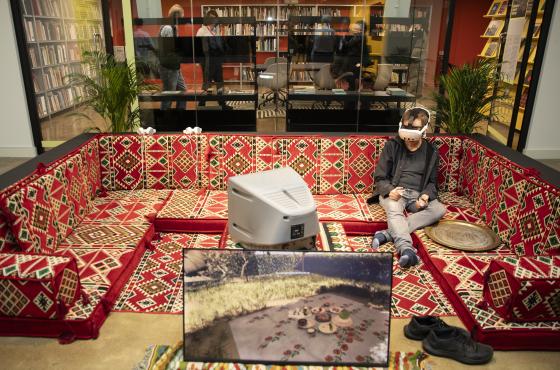
Within a virtual house inspired by traditional Baghdadi architecture, you encounter photographs that open into spaces shaped by the storyteller’s recollections and voice. Together, the photographs and recorded narratives become the material for an expanded photographic moment: an intimate encounter in which you can sit and listen to somebody’s story. The work uses the digital material and language of video games to create a space for Iraqi memories and experiences, and to challenge the dominant representation of Iraq within that medium. It is an ongoing project and is directly connected to photographic and narrative submissions to the Iraq Photo Archive.
You have a background in photography and moving image, and you have a recent interest in new technologies such as virtual reality: what do you find interesting in this medium?
Basil Al-Rawi: My practice has always moved between still and moving images. I approach photography as a medium of construction, where meaning is made through the arrangement of space, light, composition, tone and texture. I also have a longstanding interest in video games and virtual spaces, and I became interested in the possibility of using those spaces to reconstruct and expand the moment of a photograph.
A turning point was a work I began making in 2019, Baba Gurgur بابا گرگر (Father Of Flames), 1927. It began with an archival photograph of the bitumen fires at Baba Gurgur, near Kirkuk in northern Iraq, the site of Iraq’s first major oil discovery. This image was very compelling to me as I felt it was a condensation of geological time, and of the provenance of many of the traumas affecting the region and the wider world today. I wanted to make an interpretive reconstruction of that photographic moment, using slow motion and cinematic movement through space to create a kind of visual meditation on the place.
That led me towards using a game engine to spatially reconstruct the archive photograph and introduce a temporal element through a virtual cinematic camera. This idea evolved in House of Memory to bringing three elements together: a photograph, audio narration of a personal memory, and the spatial reordering of that material within a virtual environment. In House of Memory, this becomes a very intimate and emotive way to encounter somebody’s story. The stories bring back things the photograph cannot show: recollection of the scent of citrus trees in a garden, the sound of the bulbul, or the feeling in a moment. Those details shape the space, and elements of the environment appear or change as the narration unfolds. I’m interested in giving form to the atmosphere of recollection, including its gaps and subjectivity. That is what I’ve described elsewhere as the “emotional architecture of memory”.
I wanted to use VR in a way that resists the mission logic of a video game, so there is no task to complete. There are also no handheld controllers so instead you use your gaze to move through and interact with the space. That also brings attention to the act of looking: how we look matters, and what we look at matters. And yet while you are in this virtually constructed visual world, this work is also very much about listening. For me, VR is also a complicated medium because of its relationship to violence, from its use within military training simulations to its use in treating soldiers’ post-traumatic stress. I wanted to explore its potential for a different kind of encounter with photography and personal memory, and for representing Iraqi landscapes and heritage beyond their use as virtual theatres of conflict.

You are interested in changing the representation of Iraq by the general public, distorted by video game environments, computer war games, and general narratives from the media. Can you tell us more about that?
Al-Rawi: The starting point in this work is very personal and grew out of my father’s photo albums from his life as a young man in Iraq. These were images of him as a student on field trips, or joking with friends. Growing up in Ireland, those images stood in stark contrast to the imagery of Iraq that were circulating through news media, films and video games.
That contrast also affected how I understood myself: the albums offered a sense of recognition and belonging that I couldn’t find in those public images. Much of Iraq’s contemporary history (particularly visual) has been mediated by others. The narrowness of that representation has flattened thousands of years of culture, and a diversity of ethnicities, languages, food, heritage and innovation, into a very one-dimensional idea of a place and its people. I felt there was enormous potential in these personal, everyday photographs to form a community-sourced counter-archive, which could create a site of authentic representation that is mediated by the community.
I also grew up as an avid fan or video games, but many of these games used Iraq and its landscapes as a shorthand for violence and destruction. More broadly, environments associated with Arabs, or West Asia, became places where conflict was expected to happen. I remember Desert Strike, released in 1992, with the subtitle Return to the Gulf. You played an Apache helicopter pilot carrying out missions in an unnamed West Asian country, but the reference was hardly subtle. This was a hugely popular game amongst my friends (and was Electronic Arts best selling game in 1992, a year after the first Gulf War), and it was only when I was a little bit older, that I started to critically question this relationship between these mediums and how they were affecting representation and perception. So I’m interested in how these representations can become complicit in manufacturing consent for violence, and how the same media can in turn be used to create other kinds of representation. At the same time, I don’t think it is the responsibility of Iraqis, or other misrepresented groups, to keep correcting distorted Western perceptions. There is a responsibility on audiences in the West to broaden their understanding of the media they choose to encounter, and to critically analyse the modes of production and reception.
My priority was to create an opportunity for Iraqis to narrate their own stories, on their own terms, and to share the memories they wanted to share. The archive, the oral histories and the virtual environments all began with that desire to build a space around people’s own images and narratives, where images could be encountered and stories could be told and heard.

“My priority was to create an opportunity for Iraqis to narrate their own stories, on their own terms, and to share the memories they wanted to share.”
The different intimate testimonies we hear in the exhibition through videos, the VR piece, the photos storytelling, depict a time that is far gone in Iraq. What is the purpose of your project the Iraq Photo Archive?
Al-Rawi: The Iraq Photo Archive grew out of my father’s albums and a desire to gather a different kind of photographic collection. In my research, I encountered historical collections held in Western institutions that were primarily shaped by colonial expeditions and ethnography, and contemporary commercial photographic repositories (such as Getty images etc.) in which Iraq was overwhelmingly contextualised through conflict. Alongside all of that were people like my father, who were simply taking photographs of their lives. I was interested in what those personal and family archives could reveal.
The project initially drew on my own frame of reference by focusing on photographs that left Iraq with people in the diaspora. They remained in albums, cupboards and drawers, becoming touchstones of memory and connection to a place from which people were separated. The act of taking them out, looking at them and remembering is central to the project.
It is a modest archive; it doesn’t set out to be an enormous or comprehensive repository. Its purpose is to bring forward ordinary images and the reflections people attach to them. Some photographs are low-resolution or out of focus, and in some cases the only copies that exist are mobile phone photos of hardcopies that have been shared amongst family through messaging apps. What matters is the memory they hold. An image that tells a stranger very little, can carry a powerful sense of family, home or happiness for the person who kept it.
There is already a great deal of informal archiving of Iraqi photographs occurring across social media and messaging platforms. Images are copied, shared and annotated, sometimes accurately and sometimes with entirely fictitious information. That circulation speaks to a desire for a history or narrative to hold on to. For this project, keeping the photographs connected to the people and memories behind them is essential.
Many of the participants in the VR stories belong to a generation who remember a flourishing Iraq before the conflicts that would later dominate its representation. They had the experience of knowing it at that moment, alongside the pain of leaving and, in some cases, being unable to return for many years, if ever. The archive gives space to those experiences through personal recollection. Those recollections are partial and personal, and they make room for contradiction as well as affection. The project is concerned with how people remember and carry those experiences into their lives now.

What is your connection to Brussels? Why is it important for you to show your work here? What do you want the Brussels audience to go home with?
Al-Rawi: Brussels is both a European capital and a seat of power, a place where many decisions are made, and also a city where many nationalities and communities converge. So showing the work at Bozar offers a wonderful opportunity to bring these stories to that diverse audience, including Iraqis living in Brussels as well as people whose own experiences may connect with the work in different ways.
There is also the Irish dimension. I am half Iraqi and half Irish, and Ireland, where I grew up, has given me home, culture, friendship and family. Showing the work in Brussels during Ireland’s EU presidency brings that part of my experience into the picture too. The Irish experience is also deeply diasporic. Many people will recognise something in the experience of leaving home, making a life elsewhere and reflecting on that decision many years later.
I would like audiences to leave with a more nuanced understanding of the human experiences in these stories. The photographs show engagement parties, people travelling, relaxing, dancing at home and enjoying their world. These are moments many of us recognise. We often take photographs because we are happy, or because something feels like an occasion, and we want to preserve it.
I hope that familiarity allows people to connect with the stories, and to reflect on their own relationships with photographs, memory and home, and to consider the voices and details that give each memory its own character.
How did you feel while interviewing and listening to the project participants? Did it resonate personally?
Al-Rawi: Firstly, it made me deeply appreciate the time people were giving and the trust involved in sharing their memories with me. The conversations were sometimes emotional, and they gave me a deeper understanding of the decisions people have to make when their choices may be very limited.
The whole oral history process, which is ongoing, has had a profound effect on me. As I listen to people’s stories, I hear connections between their individual experiences, but I also hear echoes of my father, and it adds layers of nuance to my understanding of his experiences and stories. I began my PhD in September 2018, and he sadly passed away six weeks later, before I had the opportunity to sit down and record his oral histories. That made the experience of listening to the recollections of others particularly poignant.
It has also been a wonderful opportunity to connect with other Iraqis around the world, which has led to friendships and collaborations. Also, it’s encouraged personal reflection on the complexities of the diasporic experience, of having a deep connection to a culture that you can also perhaps at times feel very disconnected from. That was transformative for me personally.
The stories in the VR work are edited from much longer conversations. I shared the transcripts and edits with the participants, and they consented to the stories that became part of the experience. There is much more behind what audiences hear, and perhaps in the future there will be an opportunity to share more of those conversations, with the participants’ consent.
“The more stories you encounter, the more the diversity within a community becomes visible, and the richer and deeper your understanding becomes.”
To what extent can photographic archives of individuals change our collective narratives?
Al-Rawi: I think they can contribute enormously. As individual narratives come together, each adds another layer or shade to a collective picture. The more stories you encounter, the more the diversity within a community becomes visible, and the richer and deeper your understanding becomes. There is room for parallel histories, shaped by families and communities, whose differences are part of what makes that collective picture meaningful.
That was one of the most interesting aspects of the interviews. I began with open questions and allowed people to follow their memories. Sometimes I would ask them to describe the physical space or something beyond the photograph, such as a sound or a smell. But often a photograph would lead the conversation somewhere entirely unexpected. Remembering can bring pleasure, but it can also bring a sense of loss.
Archives help shape how a community or a country understands itself. National collections, and particularly the material made publicly visible, are often carefully selected and curated. A community-sourced approach creates room for other experiences to emerge. People will of course make choices about what they contribute, but they have the freedom to represent themselves.
For me, this is also about creating sites of belonging. Diasporic communities do that in many ways: an Irish community forming a Gaelic football team abroad, for example, creates a place where people can recognise themselves and feel connected. I see the archive and House of Memory as working towards something similar, from an encounter in the gallery as well as in a digital space. They make room for Iraqi images, voices and memories within a medium where the existing representations have often been deeply problematic. The house is also designed to grow, making room for further photographs, voices and memories. I see it as a place where memory can continue to be carried and shared.