Mons Frigidus (Latin for ‘the cold mountain’)
Coudenberg, one of the seven hills of Brussels, owes its name to the cool wind that is said to have once blown incessantly across it. Yet the name also resonates in a more figurative sense, for the winds of change have swept across the hill time and again throughout its history. One such moment came in 1430, when the Duchy of Brabant became part of the Burgundian Netherlands and its new sovereign, Philip the Good, made Brussels his principal residence. He had the former ducal residence on Coudenberg remodelled and extended, transforming it into an imposing palace. The crowning glory of this architectural ensemble was undoubtedly the majestic Aula Magna, the great hall built in the 1450s for receptions and festivities.
The year 1531 brought another welcome change when Mary of Hungary, the newly appointed Governor of the Habsburg Netherlands, moved the court from Mechelen back to Brussels. Mary was the sister of Emperor Charles V, who also ruled Spain as Charles I. Under Charles and Mary, Coudenberg Palace once again underwent extensive alterations and expansion. Among the most notable additions were the Renaissance-style residential wing overlooking the Warande park and the magnificent late Gothic court chapel built adjoining the Aula Magna. This second period of splendour continued uninterrupted under Mary’s successor, Margaret of Parma, until the outbreak of the Eighty Years’ War in 1568. Particularly memorable occasions included Charles’s abdication as Holy Roman Emperor and King of Spain in the Aula Magna in 1555, and the wedding of the future governor Alexander Farnese in 1565. The latter occasion brought not only the court but the entire city of Brussels alive with music and festivities.
The history of Coudenberg Palace continued to unfold under the rule of Archdukes Albert and Isabella (1598–1621), and later under Governor Leopold Wilhelm of Austria (1649–1656). It came to an abrupt halt, however, in 1731, when much of the palace was ravaged by fire. What remained standing was demolished in the 1770s to make way for the neoclassical Place Royale as we know it today.


Coudenberg ruins © Guillaume De Grieve

Coudenberg ruins © Guillaume De Grieve
Coudenberg ruins © Guillaume De Grieve
Coudenberg ruins © Guillaume De Grieve
If walls could talk
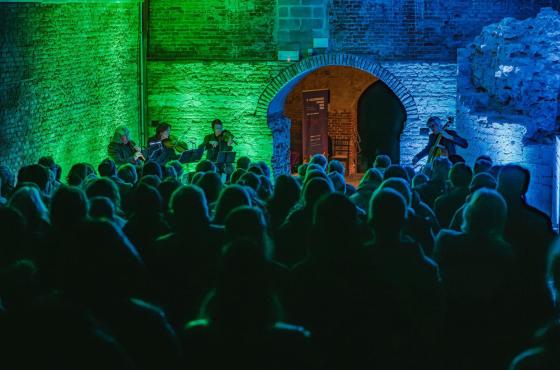
Or rather, if foundations could talk, for apart from a few floors and kitchen fireplaces, they are all that remains of this magnificent palace. And yet these foundations do indeed speak. For the past decade or so, amid an atmosphere of sheer festivity, they have been telling tales of a glorious musical past. Under the Burgundian dukes Philip the Good and Charles the Bold, both musicians themselves, the Brussels court undoubtedly resounded with the music of composers such as Guillaume Dufay, Gilles Binchois, Gilles Joye, Antoine Busnois and Hayne van Ghizeghem. Alongside dozens of singers were minstrels who showcased their instrumental skills on shawms, trumpets, flutes, fiddles, harps and lutes.
Mary of Hungary, herself a keen amateur musician, inherited from her aunt Margaret of Austria the beautifully illuminated music manuscripts of the Burgundian court library. These contained masses, motets and chansons by some of the most internationally renowned composers of the late fifteenth and early sixteenth centuries, including Johannes Ockeghem, Alexander Agricola, Josquin des Prez and Pierre de la Rue, all of whom had been in the service of the King of France or the Dukes of Burgundy. Mary also collected works by a younger generation of composers who plied their craft in major churches across the Southern Netherlands, at her own court or at those of her Habsburg relatives in Austria and Spain. Among them were Nicolas Gombert, Thomas Crecquillon and Jacobus Clemens non Papa. Mary even appears to have been well acquainted with the music of Adriaen Willaert, chapelmaster at St Mark’s in Venice. In addition to the customary singers and organists, Mary’s payroll included cornettists, shawm players, trombonists, flautists, viol players and lutenists.
Under Margaret of Parma, who governed on behalf of King Philip II of Spain, the Brussels court had its first taste of the latest Italian musical practices. At the wedding of her son Alexander Farnese in 1565, for instance, a madrigal by Cipriano de Rore was performed, and after the main banquet a five-part Italian consort played dance music. It was not until the 1580s, however, when Alexander himself became governor, that Italian musical styles became firmly established in the Netherlands, both at court and in the salons of the patrician elite. The latter development owed much to the remarkable success of the local music printing industry.
A court with a distinctly royal character
In 1598, Philip II bestowed the Southern Netherlands upon his daughter Isabella Clara Eugenia and her husband, Archduke Albert VII of Austria. Until 1621, the couple ruled as virtually independent sovereigns, and Coudenberg Palace took on the character of a fully fledged royal court. Under the archducal couple’s patronage, the musical chapel became one of the most prestigious in Europe. It comprised between forty and fifty singers and instrumentalists, drawn predominantly from the Netherlands, but also from England, Spain and Italy. Among its most illustrious figures were the chapelmasters Jan van Turnhout and Géry de Ghersem, the master of chamber music Pedro Ruimonte, the organists Peter Philips, Peeter Cornet, John Bull and Vincenzo Guami, the viol player Daniel Norcombe and the harpsichord maker Ioannes Ruckers. In 1607, the Brussels court also received a visit from, among others, the young Italian organist Girolamo Frescobaldi.