Would you like to discover Brussels' music history on a walk in the city? Download our map here.
The first stop on my journey through time is dark, chilly and damp. Yet I didn’t actually set out in search of the Dark Ages. A few storeys below Koningsplein lie the remains of the majestic Coudenberg Palace, where the Burgundians and, later, Emperor Charles V held court while the arts flourished for centuries. As the tram rumbles overhead, it is easy to picture the scene. In the fifteenth-century kitchens and storerooms beneath the vanished state hall, the remains of tiled floors, colossal columns and extinguished fireplaces still survive. A soot-black horizontal line on the walls bears witness to the fire of 1731, which completely destroyed the complex, except for the chapel.


Coudenberg ruins © Guillaume De Grieve

Coudenberg ruins © Guillaume De Grieve
On 6 December, ClubMediéval performs at the Coudenberg. Pierre de la Rue and Tielman Susato are among the composers whose music Emperor Charles V is likely to have heard during his reign in Brussels. The same ticket also grants admission to a concert by Dionysos Now! at the Coudenberg Church, featuring polyphonic works by Johannes Ghiselin, Pedro Ruimonte and Thomas Crecquillon. Together, the two concerts paint a living portrait of the Coudenberg, from a modest court chapel to an international centre of musical exchange.
That other Charles
I don’t have to go far to delve deeper into the musical history behind Echoes of Brussels. Following the devastating fire of 1731, the Habsburg governors took up residence in the Palace of Charles of Lorraine, then still known as the Palace of Nassau. On Museumplein, I come face to face with Charles of Lorraine himself, his bronze statue gazing out from beside ‘his’ palace with a proud, timeless and slightly furrowed brow. The residence is not open to the public, so I linger for a moment in its shadow.

Karel van Lotharingen statue Place du Musée © Guillaume De Grieve

Door Onbekende schilder - Karl Alexander von Lothringen, Publiek domein
Karel van Lotharingen statue Place du Musée © Guillaume De Grieve
Door Onbekende schilder - Karl Alexander von Lothringen, Publiek domein
A handful of tourists turn on their heels after taking a photograph. Little do they realise that this was once the heart of Brussels’ concert life, thanks to one remarkable composer and violinist: Pieter van Maldere. With the support of Charles of Lorraine and inspired by the Parisian Concert Spirituel, he founded the concert society Le Concert Bourgeois. Van Maldere also travelled throughout Europe with his patron, introducing ‘Brussels’ music to the international aristocracy. On 29 October, the ensemble Les Muffatti explores the repertoire of Le Concert Bourgeois and knocks Charles off his pedestal.
For the collective
My next rendezvous is with Meyerbeer. Rue Meyerbeer in Vorst, to be precise, where the composer Frederic Rzewski lived until his death in 2021. From 1977 onwards, the American composer spent much of his life in Brussels. An extensive and varied oeuvre attests to his productivity, ranging from orchestral and chamber music to the many piano works that he often performed himself. It also refutes the notion that new music is necessarily difficult. Rzewski’s works are deliberately accessible. Driven by his left-wing political convictions, he sought to make his music accessible to the working class, in contrast to the Darmstadt School led by Stockhausen and the New York avant-garde led by Cage.
His greatest achievement is The People United Will Never Be Defeated! This extraordinary cycle of variations for piano can rightly be ranked alongside the Goldberg and Diabelli Variations by, respectively, Bach and Beethoven. Based on the identically titled Chilean protest song ¡El pueblo unido jamás será vencido! by Sergio Ortega Alvarado, Rzewski composed thirty-six impressive and technically demanding variations. On 28 October, Daan Vandewalle, a friend of Rzewski’s, performs this remarkable cycle at Bozar.
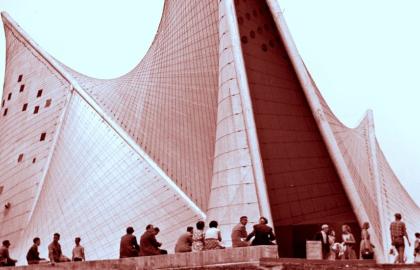
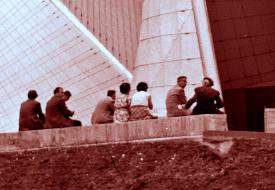
Later this season, we will revisit the 1936 performance of Schönberg’s Erwartung at the Centre for Fine Arts, featuring sets by Jean Brusselmans! We will also return to Expo ’58, where Varèse’s Poème électronique captivated visitors to the Philips Pavilion, and to the world premiere of Stravinsky’s Symphony of Psalms at the Palais des Beaux-Arts in 1930. So much still lies ahead, and so much to experience!