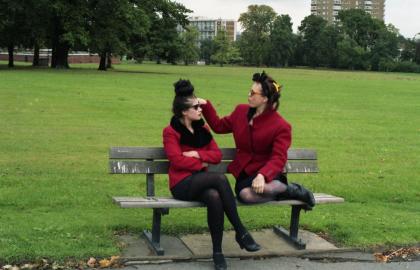
Dick is a consummate portraitist who loves humanity. Her early work is the best known, such as Guérillère Talks (1978), inspired by Monique Wittig’s novel Les Guérillères. Here Dick films each of her friends on Super 8 for the length of a reel, encouraging them to perform themselves, which creates a vision both ordinary and extraordinary. Guérillère Talks lays the foundation of an approach that she has followed throughout her career, weaving French feminist philosophy, history and politics into the everyday filmed observations.
At this time, Dick also develops a film language through juxtaposing documentary with fiction, such as in Liberty’s Booty (1980) where Dick combines interviews with sex workers and her friends acting as sex workers in a pretend downtown brothel.
In 1985 Dick moved to London. In this period, she continues to film with friends who take on acting roles such as London Suite: Getting Sucked In (1990) funded by Channel 4. The acted vignettes are juxtaposed by incidental documentary such as fragments of street scenes, friends in squats, or her young son, dancing with abandon on the sofa.
Politics is never far away, not foregrounded but steeped in the everyday and in the lived experience of her subjects. For example, in Visibility: Moderate (1981), through a narrative of an American visiting Ireland. Dick comments on the reputation of Ireland alongside its complex reality of the anti-colonial war in the North, ancient traditions still alive through the Puck Fair, the Blarney Stone etc, mediated representations of adverts and tourist Board material.
In 1999 Dick moved back to Ireland. The films produced since 2000 are more contemplative and reflect on the violence of gender imbalance such as Red Moon Rising (2015) where friends, performers and musicians, act at night in a forest that is garishly lit. The imagery is embedded in landscape because, as Dick states, “we are part of it. In denying this we are denying everything”.
Like her earlier films there is no denouement but instead a series of poetic, fragmented propositions richly served through a generosity to her subjects, a virtuosity of camerawork and nuanced sound work that adds depth to the emotion invoked by her unique filming style. Pleasure, politics and humour weave through all of Dicks films as “mismatched inserts” that surprise and delight, but at the same time remind us of the urgency of lived experience today.