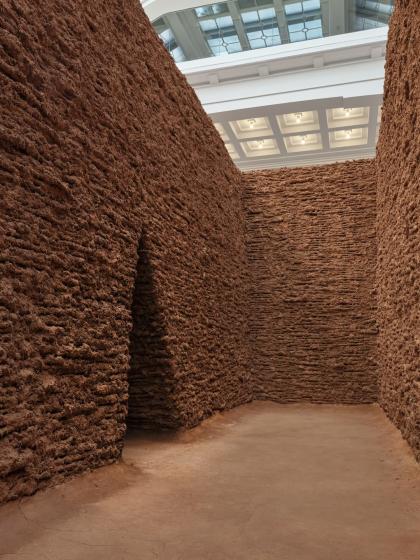
Soil isn’t just material in both your work. How did you first connect with the soil and fibres of Brussels?
Delcy Morelos: “For me, matter is alive. Earth produces and nurtures life; it is not inert. That awareness guided my first visit to Brussels for this project. I walked the city searching for local fibres, and I was inspired by traditional thatched roofs in Ghent. I’m interested in vernacular bioconstruction and the knowledge of plants that has been lost over time. I want people to reconnect with soil, with plants and their uses”.
Nicolas Coeckelberghs: “I first connected to soil in an urban context in October 2016, when Ken De Cooman (co-founder of BC) and I visited the exhibition Terre de Paris at the Pavillon de l’Arsenal in Paris. That moment sparked the beginning of BC Materials. We realized that dense urban life and local, earth-based materials could coexist. From the start, we wanted to explore how the city’s own soils could be transformed into healthy, low-carbon, and circular materials.
With BC Studies (a non-profit), directed by my colleague Jasper Van der Linden, we aim to pass on the vision of BC through education. In 2025, eighteen students from Aachen University, where BC Studies leads a sustainability-focused architecture chair called Act of Building, helped Delcy Morelos map the types of fibres available in the Brussels bioregion: willow, reed, Japanese knotweed, and more. They created material samples to support her artistic process, what we called a “Library of Material” of the Brussels region.”
Delcy Morelos, your in-situ installations often respond to architecture. How does this play out in Bozar’s Horta Hall?
Morelos: “Many people cross this hall, leading to concerts and exhibitions, screenings or talks, to the bookshop… So one challenge is to encourage visitors to pause, lift their gaze and truly see the light and architecture around them. The contrast between Victor Horta’s refined and elegant hall and my raw organic materials is striking, each revealing a unique beauty. But the Horta Hall is a mountain too, Bozar’s polished marble still remembers its origins”.
Your work engages all the senses. What do you want visitors to feel?
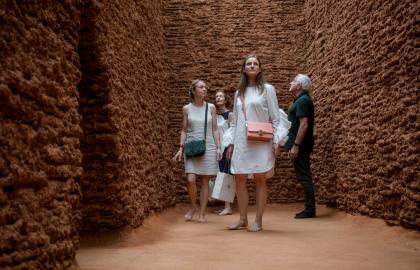
Morelos: “I’m interested in liminal states, moments between consciousness and dream. Darkness, smell… different strategies can lead you to a liminal state. Indigenous runners’ and climbers’ stories show us the power of feeling the soil. It's like entering the jungle, entering darkness where you connect with something you weren't connected to before. Walking barefoot, fragile yet grounded. It reconnects the body to ancient memories and to the Earth.”

How does your practice link to vernacular building traditions?
Morelos: “Everything is constantly changing. Ideas of luxury keep shifting too. Building with earth and straw used to be cheap, and now it’s more expensive. What was once “poor” construction has become a luxury, future-proof bioconstruction is expensive.”
Coeckelberghs: “Tradition, in many parts of the world, teaches us how to operate in balance with the environment. By bringing these lessons into contemporary architecture, we can create spaces that honour the past, serve the present, and remain sustainable for the future”.
How do you see art and science working together in this project?
Morelos: “My project highlights the “other science”, not the official academic one, but the ancestral, embodied knowledge that indigenous communities still practice. Collaborating with BC Materials lets these ways of knowing coexist with academic science and research. It’s about valuing multiple forms of knowledge that have long been overlooked but are urgently needed today.”
Coeckelberghs: “I don’t really believe in a clear-cut between art and science, or research and creativity. I believe art can translate complex ideas into visual stories or experiences, inspiring society to embrace change. Art and science don’t merely intersect; they collaborate, each amplifying the other, in the ongoing work of creating a more sustainable world.”
What advice would you give young architects and artists exploring materials and sustainability?
Morelos: “I love how chefs speak from experience, recalling childhood moments with their grandmothers cooking, as if their connection to food was visceral. That truly changed how I relate to materials. Unlike many artists or architects, who work in a rational and aseptic way, chefs engage organically and passionately with their sources. I see young architects who work with earth, and when they connect fully with the material, their joy and dedication is palpable. Ancestral knowledge is vital for shaping a better future, as Ailton Krenak says, “If humanity has a future, it is ancestral.”