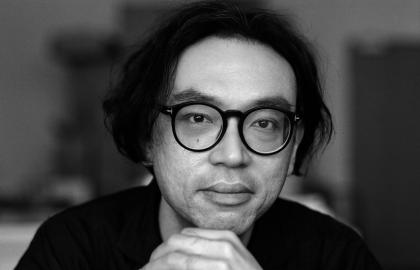
For years, one question has steered his research: How exactly could we define Southeast Asian culture? Or as the artist puts it: “What constitutes the unity of Southeast Asia, a region never unified by language, religion or political power?” Instead of giving one answer, Ho Tzu Nyen multiplies perspectives, voices, and timelines to untangle the question in an ongoing series of works titled The Critical Dictionary of Southeast Asia. Ho collaborates with musicians, works with shadow puppetry, or dialogues with algorithms capable of generating endless variations of a story, with time-based media as his primary support.
In the 'antichambers' of the Centre for Fine Arts, three major works map out the artist's vision. Central in the exhibition is T for Time (2023), a one-hour real-time video installation. Time, for Ho, is both a working material and an ungraspable concept: for a cinematographer, it is indeed the essence of moving images. The work unfolds on two overlapping screens. On the back screen: found footage run through an algorithm that blurs and reshapes it. In front: a 2D animated after-image of the same scenes, drawn by hand and constantly recomposed. Each chapter tells a different story about time, from the global standardisation of clocks to intimate family anecdotes, held together by the soundtrack of a continuous solo saxophone line. T for Time is less an answer than a cascade of new questions, and an attempt to capture the definition of Time as a key element to understand Southeast Asia’s cultural differences.

Nearby, the Time Pieces act like the preparatory notes for T for Time. The installation is made of 43 screens of different shapes and sizes, gathering Ho’s initial thoughts on Time. On a long-curved wall, the digital devices show different images, measuring, bending or symbolising Time. Some videos last a second, others up to 24 hours in a loop. A video of a motorcyclist riding through the actual time of day; a 2D-drawn portrait inspired by Hitchcock’s character of the Mother in Psycho representing the passing time; or two synchronized clocks quietly drifting apart in a nod to Félix González-Torres’ Two Lovers. Footage, apps, 3D models, animations, ... The mix is intentionally unruly, a celebration of Time’s heterogeneity.
Facing these explorations is the premiere of P for Power, the newest entry in Ho’s ongoing Critical Dictionary of Southeast Asia and a commission by Bozar. Here, Power is seen like Time: a universal concept everyone thinks they understand, until they try to define it. The video installation is structured as 30 real-time edited chapters, each a question-and-answer exchange between Ho and an Artificial Intelligence chatbot about what Power might be. Animist ideas from Southeast Asia, evolutionary biology, electricity, interspecies coordination, each of those ideas becomes a way to rethink Power as Baruch Spinoza did: not as a domination, but as the capacity to affect and be affected. Power is what continues vibrating through time, and what touches sensitivity across change. Conceived as a work-in-progress, the installation is evolutive through the duration of the exhibition, each visitor seeing a different result of the research.
Together, the three works invite viewers into Ho’s favourite terrain: a space where ideas connect, multiply, collide, and keep changing.