It is a pleasure to have this conversation with you on the occasion of your exhibition, I am not me, the horse is not mine. Brussels is a city that witnessed your early touring and many premieres of your stage productions since 1995. And I would like to start this conversation with a question on your connection and memories of the city.
William Kentridge: There were two strands of connection to Brussels. The first one was general and abstract, from when I studied African colonial history in Johannesburg and started to know about Belgium’s disastrous history in the Congo in the 19th and early 20th century. The second one was through particular people in Brussels who invited my productions here. I think mainly of Frie Leysen, the founder and former director of the Kunstenfestivaldesarts. Her interest and support for the work extended beyond the usual presentation at European festivals. Over many years, the connection with Brussels became very strong through multiple presentations of stage productions, exhibitions, and the production of my first large-scale opera. Through these productions, a team of long-term collaborators came out of Belgium: Sabine Theunissen, Greta Goiris, and Luc De Wit. They've all been long-term collaborators.

The first confrontational images of what was happening in Africa appeared in Belgium. The images coming from Congo confronted the Europeans with the colonial brutality in Africa, shattering the myth of a "civilizing mission." Art and photography played a role in exposing the colonial powers to the public.
Kentridge: We know that modernism has a complicated relationship to colonialism. Many of the greatest works of modernism came through new inspirations that artists got from seeing works that had been brought back from the colonies by either missionaries or colonial officials. So much of modernism has this influence, not in an evil way, but seeing that was an awakening of other ways of seeing the world, other ways of representing the world than the Western canon of the previous 500 years.
Talking about your long-term collaborators leads us to my next question, concerning your unique studio practice which the exhibition in Bozar highlights both spatially and conceptually. Could you describe how your studio works and how it shapes your production?
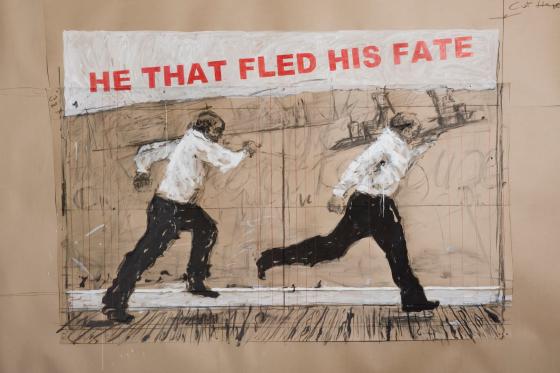
Kentridge: Initially, the studio was the space where I produced drawings. Through changing and erasing, the two-dimensional drawings became animated drawings. Later, I started to collaborate with the Handspring Puppet Company, where we would put my animations with their puppetry. Suddenly, the drawings moved into three and four dimensions, the depth of the stage, its height and width, plus the duration.
Over time, drawing and theatre activities merged. The studio grew larger, allowing rehearsals, editing, fabrication, and design to take place in one space. Editors, designers, and technicians work alongside me, making the studio a place of continuous production and revision. At the centre is still the drawing space, which remains a solitary activity. I have to do all the drawings of all the animations on my own. Beyond that, the work is deeply collaborative, artistically and conceptually. The principle also every day is that whoever's in the studio, we eat together. The collaborators are part of the authorship of the project. I love that this collaborative aspect becomes evident in the exhibition at Bozar.
You often speak about time in your process—how does it function in your studio?
Kentridge: Before drawing, there is always a preamble: walking around, gathering thoughts, delaying the work. I used to call this procrastination, but now I think of it as productive procrastination—a necessary gathering of ideas. In animation, time becomes measurable. A two-second gesture may become 50 frames, and those frames may take one or two days to draw. Then it is compressed again when the film is shown. There is a constant elasticity of time.
There are the larger arcs of time in my work too. I do one opera project every three or four years. A theatre project may take 18 months, with only six weeks of rehearsal. We start with an idea, a subject, some texts, or I might have found some images, and start to play with those, improvising with music, with sound, with movement, and finding the form, finding the language in which to think about a particular subject. Much of the time is spent developing images, animations, and ideas through workshops for each project. There is always something appearing in either the movement of the actors or in the drawings that reveals more than we know, from which we will learn.

I wonder where this collaborative spirit comes from. When I visit your studio, we speak, discuss, and eat all of us together. It is like a theatre company. Is this spirit coming from the theatre?
Kentridge: It comes partly from theatre, but also from the political context of South Africa in the 1980s. During apartheid, theatre was one of the few spaces where certain things could be said openly. Workshop theatre created a way for people from very different backgrounds to work together. It levelled the space by focusing on improvisation and shared making. For a few hours, there was a sense of equality—a kind of provisional utopia. Outside such spaces, there was a silencing of black voices and the privileging of a kind of European critical intellectual tradition that swallowed all the air. Through workshop theatre, plays were made from the ground up by the participants, using the different life experiences that people had as a kind of meeting ground, which was otherwise very rare in South Africa. That experience has stayed with me. Even today, collaboration remains a way of bringing different histories, languages, and perspectives into a shared process.
Your work often includes what I would call “cross-temporal collaboration,” bringing together figures and ideas from different times and places. Could you elaborate on this? The clearest example is your video installation To Cross One More Sea.
Kentridge: This work is based on a historic journey from Marseille to Martinique for refugees escaping the Vichy government in France in 1941, but it is also about other journeys across the Atlantic. There were some associations for me, the first one was, of course, Martinique. I immediately started to think of Aimé Césaire and Frantz Fanon. Neither of them was on that particular boat. From the same village of Aimé and Suzanne Césaire came Napoleon's wife, Josephine. So we can certainly have Josephine Bonaparte. If you've got Josephine Bonaparte, why not Josephine Baker? Two years earlier, Trotsky escaped Europe and the Soviet Union to Mexico, he could also join.
Do we understand the world in racial terms, the way Fanon and other Africanists would have said, or do we understand it in class terms, the way Lenin would have said? This was a real argument and dispute in that period in the 1940s and was the dominant debate in South Africa when I was a student, and afterwards in the 1970s and 80s. The gathering creates a network of associations across time—colonial histories, migration, politics, and culture. It allows different narratives to coexist and interact, rather than presenting a single linear story.
I would like to talk about the absurd in your work. Starting in the eighties, during and after the struggle against the apartheid regime, you did many drawings on Ubu Roi of Alfred Jarry. I guess it was a way to face the craziness of the authorities or the apartheid regime. The exhibition at Bozar starts with your drawing of Ubu Roi, and your work on The Nose by Gogol. What can we learn from the absurd today?
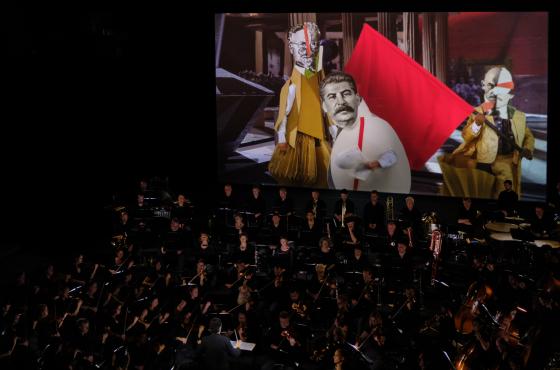
Kentridge: If the world is so crazy to try to describe it in rationalist Cartesian terms, you often miss something, you simplify it, you shift it, and change it. The absurd is, in a way, a form of realism. When the world itself is irrational, describing it in purely rational terms can be misleading. Absurdity follows flawed logic to its extreme conclusions, revealing the underlying contradictions. This was true of apartheid, where systems were both meticulously organised and fundamentally absurd. I have been interested in this approach since I was young. It remains a way of engaging with the complexity of contemporary reality. This is clear through Dada, Kafka, Gogol, and others.