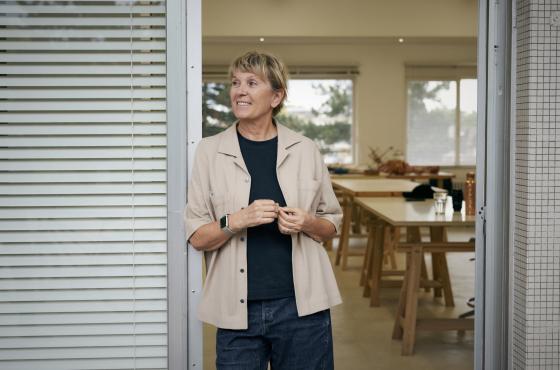
Here at Bozar, you’re presenting your performances as part of a programme that also features the exhibition Edith Dekyndt x Cristóbal Balenciaga. The Fabric Decides. What strikes you about Dekyndt’s work?
Darius Dolatyari-Dolatdoust: What particularly resonates with me in Edith Dekyndt’s work is the way she explores textiles in relation to space, particularly through forms that can become monumental and abstract. Textile art is still too often associated with women or domestic practices, reflecting a cultural legacy shaped by patriarchal structures. Yet it addresses much broader questions relating to how we inhabit, construct and organise our environment. This relationship between textiles, the body and space also runs through my own work. I see costume, set design and architecture as forms that, at different scales, envelop, protect, constrain or transform the body. Clothing can be thought of as an intimate architecture, while architecture itself constitutes another kind of covering.
How has your relationship with clothing changed over the course of your career?
Darius Dolatyari-Dolatdoust: My journey began with an approach to clothing as an object to be made and sold, before moving towards sculpture, then choreography and performance. These different practices continue to interact in my work today. I’m particularly interested in the costume collections at the Théâtre national de Bruxelles, in garments that already carry stories, uses and gestures, and sometimes even the memory of the bodies that have inhabited them. Rather than continually producing new objects, I want to explore the possibilities of transforming and activating existing forms.
A costume designed for dance undergoes an especially intense process of activation. What interests me, though, is that the choreography can already be embedded in its design: a cut, a volume, a weight or a material can induce movement, alter posture, extend a gesture or give rise to new ones. Costume therefore does not simply accompany the dance. It can become the starting point for a choreographic language, a proposition addressed to the body.
So how does the costume become part of the choreography?
Darius Dolatyari-Dolatdoust: Costume has the ability to shift the contours of the body, alter our perception of the silhouette and sometimes even blur what we recognise as human. I’m particularly interested in the way it can give rise to hybrid figures, presences that escape our usual categories. By transforming the body’s proportions or concealing certain parts of it, clothing directly affects how we stand, walk and move.
These transformations also open up a space in which to reflect on identities, particularly queer identities, and on our relationships with other species. In Flags Parade, for example, I explored the courtship displays of birds and the ways in which plumage, colour and movement contribute to forms of seduction and communication. In some species, the body itself becomes a surface of signs, a visual and gestural language.
I’m interested in these behaviours because they allow us to imagine other ways of thinking about self-representation, seduction and the performativity of identity.
So clothing doesn’t just change how we move: it also produces meaning.
Darius Dolatyari-Dolatdoust: There’s a reciprocal relationship between the body and the costume. I asked the performers I work with: Does the body set the garment in motion, or does the garment make the body dance? We tend to think of the human body as the one that decides, controls and organises movement. Yet a costume can offer resistance, impose a rhythm or suggest an unexpected gesture. The idea is to explore a different kind of relationship, in which the dancer sometimes accepts that they are no longer the sole initiator of movement, allowing themselves to be guided by the material.
This physical dimension also has a social and symbolic one. A skirt and a pair of trousers don’t invite the same gestures, but neither do they convey the same meanings. Our clothes bear the traces of an era, of conventions, of gender and class relations, and of the groups to which we belong. Costume therefore operates on several levels: it physically transforms the possibilities of movement while also shifting the meanings we attach to the bodies that wear it.
What is DRESSING about?
Darius Dolatyari-Dolatdoust: DRESSING unfolds as an extremely long dressing ritual, a gradual metamorphosis in which hybrid, almost insect-like figures progressively acquire a human appearance. The costume is at once a sculpture to be activated, a covering and a means of transformation. As layers accumulate, the bodies change proportions, straighten up and eventually form three monumental silhouettes. The colour red is omnipresent, gradually absorbing the bodies into a mass of colour until a kind of living monolith emerges.
There’s something burlesque and grotesque about this transformation, inspired in particular by Bruegel’s hybrid figures, those composite creatures in which the boundaries between species seem to dissolve. But the metamorphosis also offers a deliberately absurd vision of our humanity. It’s as though animals, dressing up to become human, eventually adopted military marching as the ultimate expression of this condition. This image makes me laugh as much as it unsettles me. It questions the idea that we are somehow superior to other species. What if humanity, in its obsession with control, order and domination, were ultimately a profoundly ridiculous condition?

In mata!, you use a highly codified costume, that of the matador, as your starting point. What did you want to transform?
Darius Dolatyari-Dolatdoust: The matador’s costume is fascinating because its codes have remained virtually unchanged since the nineteenth century. Together with Grégoire Schaller, the piece’s co-author, I travelled to Madrid to visit the sastrería Fermín, where we could observe the techniques used to make the costume and better understand how this silhouette is constructed.
I decided to retain the traditional pattern but radically change the material. Whereas the original costume is designed to shine, catch the light and reflect it, I used felt, which absorbs light instead. This choice also allowed me to symbolically reintroduce the animal into the costume through the sheep’s wool. I wanted to bring the animal back onto the body of the person whose role in the arena is precisely to kill it. In this way, the boundaries between matador and bull begin to blur, as do those between domination and vulnerability.
The matador also embodies a highly theatrical form of masculinity. His posture, thrust-out chest and structured jacket construct an image of virile authority. Yet this silhouette also relies on elements that contemporary conventions might associate with femininity: tights, ballet flats, tight-fitting trousers and a defined waist.
It’s this ambiguity that interests me. Drawing on the idea of drag kings, we seek to exaggerate the codes of masculinity, shift them and reveal them as constructed. The matador becomes a choreographic playground in which the signs of power, virility and domination can gradually turn against themselves.
This is the first time you’ve presented your work in Brussels. What does it mean to you?
Darius Dolatyari-Dolatdoust: This presentation has a particular resonance for me, as I studied in Brussels, first at the Beaux-Arts and then at La Cambre. Although I’ve had the opportunity to develop and present a significant part of my work in Flanders, this is the first time my performances are being shown in Brussels.
Returning to this city with these pieces therefore marks an important moment in my career, and I’m particularly happy to be able to share them here.