It must have been sometime in 2016 when I accidentally stepped into the former space of Wouters Gallery on Rue de la Régence in Brussels, where Eli Cortiñas’ video work The Most Given of Givens (2016) suddenly struck me like an earthquake.
A staccato of images and sounds seized my senses before I could gather my thoughts. Fragments of colorful Disney figures and black-and-white-images of masks clashed and intertwined, histories flickered and fractured, and the air itself seemed charged with urgency. The screen did not simply project; it pulsed. I found myself caught between fascination and disorientation, as if the ground beneath familiar visual regimes had begun to tremble.
It was the first time I encountered Cortiñas’ mesmerizing work—and the beginning of a long-term collaboration and friendship. What makes Cortiñas’ media art practice so compelling? How does she succeed in challenging and destabilizing image archives so forcefully? From my perspective, it is her bold strategy of dismantling and reassembling images, embedded in ideological and commercial contexts, through montage and collage techniques. Over the past years, Cortiñas has continuously expanded and intensified her exploration of montage/collage as a critical and analytical tool—one that not only exposes the ideological underpinnings of visual culture but also reclaims its fragments to construct new, resistant narratives.
The three-channel installation The Most Given of Givens critically interrogates the racist mythology of the Tarzan film saga and its enduring construction of Africa through a Western cinematic lens. Cortiñas juxtaposes ethnographically styled footage with brightly lit studio scenes in which an all-white cast performs before a literal ethnographic backdrop, interweaving these sequences with fragments from Chris Marker and Alain Resnais’ Les Statues meurent aussi (1953).
Drawing on found footage, her own recordings, and Walt Disney animations, Cortiñas dismantles the visual artifacts of Western civilization and its imperial gaze. Classical Greek ruins, for example, are set against idealized images of “nature,” exposed as landscapes already shaped and exploited by human intervention. Through this dense, layered montage, she reveals the persistent structures of colonial power embedded in the adventure genre and questions how its visual regimes continue to shape and normalize racist perceptions of the African continent today.
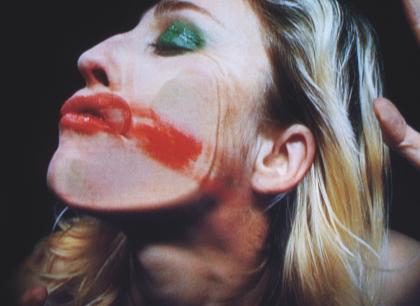
Another example is her video installation The Excitement of Ownership (2018), presented in the exhibition Resistant Faces, I curated at the Pinakothek der Moderne, Munich, in 2021. In this two-channel work, Cortiñas scrutinizes, through relentless close-ups, the stereotypical representation of the female face and body across social media, television, and feature films. Sequences ranging from black-and-white cinema to the saturated aesthetics of video games unfold against an abrasive soundtrack that intensifies the sense of visual assault.
By foregrounding the logic of the “male gaze,” in dialogue with Laura Mulvey’s seminal critique, Cortiñas exposes this historically entrenched mode of seeing as a structure of power. Since early Hollywood cinema, the female body has been framed as sexualized and passive—offered up to a presumed male viewer—while male protagonists propel the narrative. Women, in this schema, are reduced to the “passive bearer of the look”: ornament rather than agent.
Through precise montage, Cortiñas demonstrates how these staged clichés persist in contemporary culture—in the hyperreal design of sex dolls, in humanoid robots such as the AI-equipped Sophia, in digital avatars in video games, and in gendered role models within the service industry. The work adopts hybrid manifestations of the digital image: circulating as a looping video, expanding into monumental wallpaper-like stills, and unfolding as an immersive audiovisual environment. By sampling, repeating, and reframing found material, Cortiñas renders visible the textures and politics of digital imagery, offering a sharp and subversive reflection on the vast, seemingly uncontrollable archive of the internet.
In her most recent works, she turns explicitly to artificial intelligence—simultaneously employing and dismantling its mechanisms of control. Surrender, Dorothy! (2025) emerges from her long-term research project I’d Blush if I Could, which investigates bias in digital archives and the persistent feminization of AI systems. Combining archival footage, AI-generated imagery, and commercial beauty filters, the installation critiques structures of power, surveillance, and violence, while playfully engaging with digital skins, glitches, and surface effects.
Conceived as a multi-channel audiovisual collage, the work interweaves found material with self-recorded performances and expands into physical space through wallpaper, metal bars, and sculptural elements. Drawing on Legacy Russell’s Glitch Feminism, Cortiñas explores how digital errors, distortions, and avatars can unsettle fixed constructions of gender and identity.
Cortiñas’ own image—altered through Snapchat filters—appears alongside footage of tanks, police forces, and surveillance technologies. The seductive smoothness of beautified faces collides with the apparatuses of state control, echoing Beatriz Colomina’s reflections on how surveillance increasingly dissolves the boundaries between public and private space. The title alludes to The Wizard of Oz, where Dorothy’s femininity is carefully staged and manufactured—an apt metaphor for Cortiñas’ incisive critique of aestheticized control and systemic power in the age of AI.
It is precisely this relentless practice of dismantling and reassembling images that enables Cortiñas to expose the hidden architectures of power within visual culture—and to open the archive toward new, resistant ways of seeing.