Almost half a century has elapsed since a major retrospective was dedicated to Brusselmans. We follow the artist from his early forays into Impressionism and Expressionism to a series of caricature-like experiments from his later years. Painter by Nature charts a course through the intervening ‘heroic period’ – most of the 1930s – across different genres of painting: landscape, still life, interior, (self-)portrait and seascape. Along the way, the exhibition also includes two bonus interludes: a drawing and print gallery that offers a glimpse into the painter’s artistic laboratory, and a detour to the sets for Arnold Schönberg’s Erwartung [Expectation](1936).

Painting like Wouters
We first meet Brusselmans in 1914. He is thirty years old and friends with Rik Wouters. The years 1912 to 1914 were among Wouters’ finest, and he swept an entire generation of Brabant painters along in his exploration of colour and light. The major innovations in twentieth-century painting – Cubism, construction, abstraction and distortion – had yet to take full hold in Belgium. It is precisely this (r)evolution that unfolds at a rapid pace in Brusselmans’ work.
The gifted Rik Wouters made the influences from Paris his own in canvases brimming with joie de vivre. An exceptionally skilful draughtsman, he also adopted a sketch-like approach to painting, as if he wanted to capture fleeting moments before theyvanished forever. Brusselmans’ brushstrokes take the form of loose dashes, following in the footsteps of Van Gogh and the Pointillists. The domestic scene featuring his naked wife, Marie, lacks the virtuosity of the vibrant scenes in which Nel Wouters takes centre stage. Brusselmans was not a born Impressionist or portraitist. He did, however, possess a keen sense of colour and composition from an early age.
Dilbeek as a turning point
After the war, developments followed rapidly. Here you can see what Rik Wouters did not live to witness: the breakthrough of Expressionism in Flanders and Brussels. Brusselmans, too, came to be labelled an Expressionist. Only in the 1920s does that label seem somewhat justified. His palette becomes more earthy. The painter depicts manual labour: workers on the quayside in Anderlecht and farmers gathering the harvest in Dilbeek. But unlike Constant Permeke, he does not seek an expressive exaggeration of the toiling human figure. For Brusselmans, the arrangement of figures within the composition takes precedence, much as it does in a group scene by Rubens. He paints archetypes rather than people of flesh and blood: recurring figures that reappear throughout his work. In Boeren [Farmers], note the woman at the centre wearing the characteristic straw hat. We encounter her again in other paintings, holding an oil lamp or a jug. In Oogst [Harvest] (1934), Brusselmans depicts the woman in profile, like a figure cut from paper.
Where does the true turning point in Brusselmans’ oeuvre lie? In the 1930s? That is certainly his mature period, which includes many of his masterpieces, several of them now reunited in Brussels. Autobiographically and thematically, however, the decisive turning point came earlier, in 1924. That year, Brusselmans bought a house atop a hill in Dilbeek, then still a village set among rolling fields and small market gardens. The sloping street where the painter lived and worked was posthumously renamed J.B. Brusselmansstraat. Brusselmans called his house De Kouden Haard (The Cold Hearth), a play on words referring to the neighbourhood then under construction: Kaudenaarde. A poor painter’s hearth remains cold. As the years passed, Brusselmans found himself living increasingly among the wealthy Brussels residents building villas in Dilbeek. The parcelling of land gradually reduced the patchwork of small fields. Yet Brusselmans’ abstracted landscape has endured. It was not in the city of Brussels, where he was born and lived in various neighbourhoods until the age of forty, but in the Pajottenland that Brusselmans became a modernist.

Large interior, 1939, oil on canvas, Musea Brugge – Groeningemuseum © artinflanders.be, photo: Hugo Maertens

Farmers, 1928, oil on canvas, Museum of Fine Arts Ghent (detail) © artinflanders.be, photo: Hugo Maertens
Large interior, 1939, oil on canvas, Musea Brugge – Groeningemuseum © artinflanders.be, photo: Hugo Maertens
Farmers, 1928, oil on canvas, Museum of Fine Arts Ghent (detail) © artinflanders.be, photo: Hugo Maertens
The world as a construct
After De Kouden Haard, you enter The Anatomy of the Landscape. It is as if the landscape were a body or a mannequin whose limbs the painter assembles. Brusselmans found the necessary forms in his surroundings: the rectangles of the market gardens, the expanse of colour on a blank façade, the crossed sails of the Luizen Mill in Neerpede, and the semicircle of the footbridge over the canal in Anderlecht. Once he had mentally absorbed a landscape, he no longer needed to look at nature. Back in the studio, what he had seen evolved into a mental landscape, constructed from circles, rectangles and diagonal lines. The view became a vision.
Brusselmans approached his interior scenes methodically. Interiors gave way to still lifes assembled from various elements. In Keuken [Kitchen] (1935), Marie is grinding coffee. The red jug and the oil lamp – familiar elements in numerous still lifes – stand above the stove. Like Giorgio Morandi, Brusselmans arranged and rearranged the same objects time and again. Not to uncover the soul of a jug, but to explore the visual possibilities of the inanimate object.
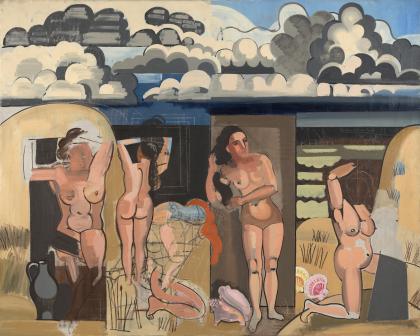
Brusselmans treats objects and the body on an equal footing. In the gallery The Dynamic Body, he is joined by Fernand Léger. Like the French artist, Brusselmans appears to assemble bodies. It is not the likeness or psychology of a portrait that interests him, but the human figure as an interplay of lines, shapes and volumes. In doing so, he places himself within the artistic (r)evolution that began with Paul Cézanne. For the godfather of modern painting, the visible world could be reduced to simple, underlying forms. And once you see it, everything else is child’s play.
Brusselmans’ paintings appear childlike in their simplicity. Yet behind that simplicity lies a painter’s way of looking and looking again; of dissecting and reassembling. As a viewer, you find yourself in a field of tension where opposing forces keep the paintings in motion: still and dynamic, appearance and insight, rough and finished, two- and three-dimensional, reality and fantasy, figurative and abstract. It is a pleasant place to be.