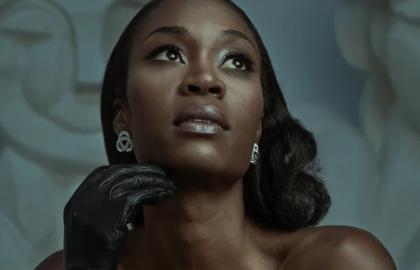
What was it like growing up in Trinidad and Tobago and what role did music play in your childhood?
Jeanine De Bique: 'One of my strongest early memories is being sung and rocked to sleep in my grandmother’s arms on a warm day. At the end of her soothing song, she always sang her name to me, which was also my middle name. Music was always present in our family. Even our television advertisements always had a musical soundtrack, usually of calypso. I was the child that was excited waiting for the ads to come on so I could dance and sing all the words (laughs) My grandmother sang regularly as a soloist in our Anglican Church, my mother played organ and piano when she was a child, my sisters were in their school’s choir, danced ballet and played the piano, my father loved playing cd’s of classic rock and I still remember the Phantom of the Opera album by sister owned that I learned all the words to and daydreamed what it would be like to see the musical in person. I followed a similar path to my sisters in, choir, dance and piano playing, where I learned both the classical and our traditional folk music. I even owned a mouth accordion!'
So you used to sing in church yourself, too?
De Bique: 'At church we sang hymns adapted from the works of composers such as Johann Sebastian Bach and other Baroque masters even though I did not realize it at the time, and these early memories shaped my lifelong love of music.
I experienced deja vu when I performed Bach’s St Matthew’s Passion for the first time with the Rotterdam Philharmonic. Hearing it for the first time in its’ entirety felt as though I was back home attending a service in the Anglican Church. As the chorus sang certain numbers, I almost yelped out in the middle of the performance, “I know this song!” In that quiet moment, with an astonished look on my face glaring at the score, I realized I was back at church singing with my grandmother and the congregation. It was the same music but with different text. It was an exciting moment for me which brought happy tears in realizing the connection between my two musical worlds at home in the Caribbean and the classical traditions of Europe. My mission became clearer of demonstrating how connected our worlds are.'
It’s remarkable how the music traveled: first from Europe, across the ocean to the English colonies and then back to Rotterdam, where you were when you realized this.
De Bique: 'The biggest realization for me was just how deeply connected our worlds are. When you look at history—colonization, industrialization—you begin to see that our stories have always been intertwined. We try to separate ourselves from one another, but we simply can’t. That realization became a big part of my mission: to show people how beautiful those connections can be, how much we can learn from and appreciate each other and music is the clearest example of this connection.
People often ask me, “Is there classical music in the Caribbean?” And my answer is always, “Of course!.” But then it’s followed by “how come?”. The answer is in history. Classical music arrived in the Caribbean through colonization. Those histories are painful and should never be forgotten and in the Caribbean we transformed what we inherited, and created a rich musical culture that reflects our resilience, diversity, creativity and unity.'

We talked about classical music in your life, but there's also another side of your musical upbringing that you'll be presenting to us?
De Bique: 'Two major music competitions supported Classical music in Trinidad and Tobago. SANFEST and The Trinidad and Tobago Music Festival. Whilst I was in Primary and Secondary schools, I took part in these competitions with my school’s choirs and in the soloist & duet categories. We competed in the folk and classical music categories and my friends and I absolutely loved it. Music is a significant part of our culture and as children it was a big part of our lives. When school was ended we would rush off to choir practice determined to win the best girls’ choir category. It was at school that I explored with folk music and calypso which defines part of our country’s brand and culture. When I was about 7 or 8 years old I even won my primary school’s calypso competition and was crowned Calypso Queen of the Year with a calypso that my mother wrote for me (laughs). Trinbagonian people sing, dance, act, and perform from a very young age. We’re an incredibly expressive and outgoing society, and the arts are woven into everyday life.'
There are two projects in which you will combine the two traditions – classical and more folky. One is with the American ensemble Apollo’s Fire.
De Bique: 'With Apollo’s Fire, we explore and ask the question: what was happening in the Caribbean during the eighteenth century, and what were composers like Handel, Purcell, and Vivaldi doing at the same time?
Jeannette Sorrell—Apollo’s Fire’s music director—together with other colleagues discovered evidence that Handel had financial ties to the slave trade through his investments. For me, that makes the conversation even more complex and the music even more meaningful. As a Black woman from the Caribbean, performing and engaging deeply with baroque music takes on a particular personal significance. It’s about embracing the beauty of the music while also acknowledging the difficult histories connected to it.'

Jeanine De Bique in Bozar with Gli Angeli © Aude Vanlathem

Jeanine De Bique in Bozar with Gli Angeli © Aude Vanlathem

Jeanine de Bique © Tim Tronckoe
Jeanine De Bique in Bozar with Gli Angeli © Aude Vanlathem
Jeanine De Bique in Bozar with Gli Angeli © Aude Vanlathem
Jeanine de Bique © Tim Tronckoe
How are you going to tell this story to the audience?
De Bique: 'We’re using poetry and spoken texts between the musical works to create the connection. Rather than presenting the Baroque and Caribbean traditions as separate worlds, we’re highlighting parallels between them, particularly in their stories and characters.
For example, an aria from Handel’s Alcina depicts a sorceress which leads us into a Caribbean folk tale about the mysterious female character known as La Diablesse, where we discuss the emotions of these two hearts. Through an act of resilience, an aria from Pepusch “O welcome gentle death”, is paired with a Haitian funeral poem and song that celebrates the speaker’s life and not sadness in death. Throughout the program, poetry acts as a bridge, allowing the music and stories to mirror one another and reveal unexpected connections between Baroque Europe and the Caribbean.'
The folk songs are arranged for an instrumental Baroque ensemble. Are there any challenges in doing this or, on the contrary, unexpected beauties that come out of it?
De Bique: 'Traditionally, Caribbean folk music is performed with instruments such as the cuatro, guitar, bongos, güiro, and string bass, along with many other instruments that are unique to the region and also what was allowed. So one of the questions I asked was: what would happen if this music were reimagined through the lens of baroque instruments? What we discovered was that the combination felt surprisingly natural. The different stringed instruments create beautiful new colours and textures, and in some of the slower songs, the lute and mandolin added a real sense of warmth and intimacy. We also found that instruments like the recorder and percussion captured something very familiar to Caribbean ears—the feeling of movement, storytelling, and even the sounds of birds and nature that are part of everyday life at home. In the end, it didn’t feel like two different musical traditions coming together. It felt like they had been speaking the same language all along.'
On 10 January, you’ll join the Freiburger Barockorchester for an all-Mozart programme. I feel like Handel and Mozart's have always been by your side. What attracts you so much to their music?
De Bique: 'Handel is one of my most performed Baroque composers throughout my professional career, though not my most performed staged composer. When I was about sixteen years old one of my first Mozart pieces was Alleluia from Exultate Jubilate - a challenging coloratura piece that my first voice teacher sometimes. Mozart and Handel have always felt like a trail fit for my voice. Their music teaches me about what my voice is can do.'
You have a multifaceted range of roles including Violetta, Micaela, Agathe, Cendrillon, Musetta and Bess. Have you faced any challenges after performing Mozart and Handel?
De Bique: 'Handel and Mozart help shape me as an artist both emotionally and technically with every role. Handel’s Rodelinda for example, is a true tour de force, tracing a woman’s emotional journey across six virtuosic arias that demand an extraordinary range of colour, expression, and vocal agility. Before singing Violetta in La Traviata, I was warned of the role’s difficulty and the vocal demands. To that I say: there’s nothing quite like singing a Handel heroine and I welcome new roles and I’m excited to explore composers new to me which I can bring my skills to.'
The final project is with the Belgian National Orchestra. There's Gorecki's Third Symphony on the programme, but also a beautiful song cycle, André Previn’s Honey and Rue, with lyrics by Toni Morrison.
De Bique: 'I am really excited about this concert! I've longed to sing Andre Previn’s Honey and Rue with orchestra, having sung it regularly in recital throughout my career. I was also fortunate to coach the piece with the late composer in person, making this performance especially meaningful to me. Equally I’m excited for the task of learning a new language in Goercki’s s Third Symphony and discovering the connections between these two remarkable works that invite us to reflect on our history, suffering, forgiveness, resilience and love. I’m honestly looking forward to working closely with Maestra Lidiya Yankovskaya and the orchestra in sharing these powerful stories and their relevance with the Belgian audience.'
As well as Jeanine De Bique’s series of concerts as Bozar’s portrait artist, don’t miss her performances at La Monnaie, notably in the title role of Romeo and Juliet by Gounod.