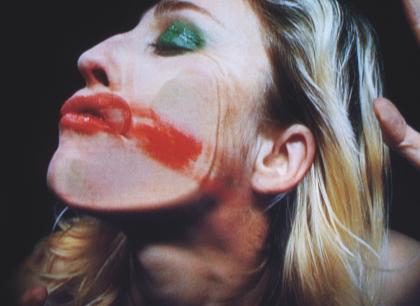
Two hands glide over skin. They rub oil into a muscular body. Slowly and methodically. Over the shoulders, along the arms, across the back. The muscles stand out beneath the skin. Bulges, lines, and contours. The oil emphasizes every detail, accentuates every muscle, and makes the body shine — defined and sculptural. You can hear it: the friction of hands on skin. The sound of oil being spread, centimetre by centimetre. The camera skims over the body, following every caress. You can see how the muscles react to the touch, how the oil seeps into every crease. Every pore, hair, and shimmer becomes tangible. Light reflects off the wet surface. You can almost smell the oil. The camera is so close that you can almost feel what you see. So close that the boundary between looking and touching almost dissolves.
We see parts of a face. Red lips, glittering jewellery, false eyelashes. An introspective gaze, eyes closed, preparing for extreme concentration. The camera follows a female bodybuilder as she prepares for a competition. She begins to strike poses. She turns, bends, and tenses her body into positions intended to be judged. Each posture is precise, trained. Arms outstretched, muscles tensed, shoulders back. She knows the choreography. She knows her best angles, and how the light should fall. But there are no fellow competitors, no audience, no jury. I am the only spectator.
I am watching the film Double You Double You (2019) by Laure Cottin Stefanelli, which focuses on a Belgian professional bodybuilder.
She prepares to be judged, but no one is there. The competition is staged. And yet the action is no less deliberate. This paradox fascinates me. It makes me think: how often do we do this ourselves? Preparing for the gaze of others. Presenting and adapting ourselves for judgement — or for the imagined possibility of it.
This bodybuilder’s physique is the result of iron discipline and strict dietary and training regimes. Her large, powerful, muscular body runs counter to contemporary beauty ideals: thin, frail, petite bodies. And yet she follows the same pattern. Discipline. Control. Shaping the body according to rules — only with a different goal. Becoming bigger instead of smaller. Stronger instead of slimmer. But always: modifying the body to meet a standard.
Must a female body always be shaped? Always controlled, disciplined and adapted?
For women with powerful, muscular bodies, judgement is not abstract. I think of top athletes who are publicly ridiculed because their bodies are too strong, too muscular, too ‘masculine’. Women who are excluded from competitions because their bodies are seen as a threat.
And yet, a soft body is not good enough either. It must be lean, toned, controlled. Strong is too masculine. Soft is too weak. Only one shape seems acceptable.
Why do we struggle to accept different shapes? It is all-pervasive: face-smoothing, body-slimming, and skin-perfecting filters. Drugs developed for the treatment of medical conditions have been normalized for weight loss — as if our natural body were a problem that needs to be solved. Fitfluencers present bodies as projects, discipline as a virtue, and transformation as proof of willpower. Why do we all try to fit into the same mould? To satisfy the judgement of others? Or to control that judgement ourselves?
And yet we also see resistance. People who refuse to display their bodies any longer. Who embrace ‘body neutrality’ instead of ‘body positivity’. But even that resistance contains an acknowledgement: the gaze is omnipresent.
Perhaps it begins with recognizing that gaze – and realizing that we, too, are spectators.
I think back to the bodybuilder in Stefanelli’s film. She prepares to be judged, but there is no one there. Only the camera. And yet she continues with the poses, with the preparation, with the ritual. And I recognize it. Because we do this too, every day. Preparing, adjusting, performing for a gaze that may not even exist. As if we are forever being watched — even when no one is looking.