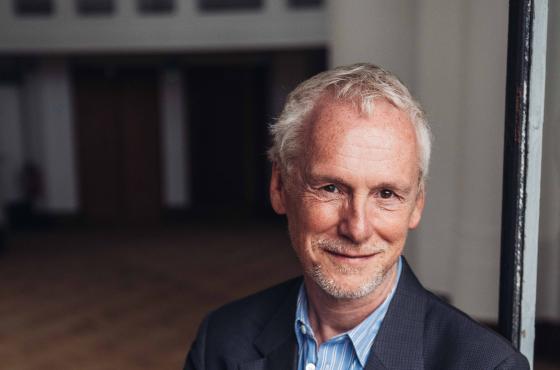
For the retrospective Jean Brusselmans. Painter by Nature, contemporary artist Kristof Santy was commissioned to recreate two of the lost stage sets. It was a special invitation, as Santy has long regarded Brusselmans as a kindred spirit: ‘Brusselmans taught me that painting is not a question of depiction, but of constructing something with paint.’ That idea also forms the basis of his approach. Santy consciously chose not to replicate the original images. Without projections or technical aids, he has sought to imagine how Brusselmans might once have constructed the sets. He is not creating literal copies, but new interpretations: works that do not reproduce the past, but instead bring it to life.
Schönberg’s Erwartung was a bold choice for its Brussels premiere, contrary to what the title might suggest. With its atonal music and psychological intensity, it broke with the traditional conventions of opera. The composer did not seek to tell a story, but rather to give voice to the inner world of his protagonist. Time, space and logic seem to exist in a state of constant flux. Brusselmans, in turn, found a fitting visual language for this turbulent emotional landscape: a painterly counterpart to Schönberg’s musical expression. Forests are not depicted as realistic landscapes, but as charged spaces in which fear and disorientation become tangible.
Today, these different temporal layers are woven together once more. Archival material, memory, painting, music and contemporary artistic imagination are reassembled into a single narrative. The return of Erwartung is not confined to the exhibition galleries. In December, the Belgian National Orchestra will once again bring Schönberg’s masterpiece to the stage of the Henry Le Boeuf Hall. The music thus returns to the very venue for which Brusselmans designed his stage sets almost a century ago. We’ve waited a long time for this Erwartung, but after ninety years, the sets are finally finding their way back to the Centre for Fine Arts. Not as a reconstruction of the 1936 works, but as a (re)assembly for 2026.