What appealed to you in For Philip Guston, a piece for flute, piano and percussion?
Ann Veronica Janssens: It was the fact that the duration of the piece gradually immerses the audience in softness and apparent simplicity. It is intended as an ‘open’ work. You can walk away from it and then come back again. You get the feeling that you are undergoing several variations of an experience you believe you’ve had before, but that no two iterations are ever quite the same. The piece reminds me of listening to birds having a conversation: you don’t understand what they’re saying, but it’s wonderful to hear. What interests me are impalpable forms, elusiveness, and that is something you can experience fully by listening to For Philip Guston. My intention with this performance is to bring the musicians and the audience together as highly sensitive actors.
Absolutely. And it’s true, Feldman is playing a game with perception. Sometimes he repeats motifs for an hour, even two hours.
Ann Veronica: It’s a disconcerting experience, an idea that stimulates us. Is our memory playing tricks? Have we experienced this moment before? Have we heard this motif before?
Do you apply that principle to your own work?
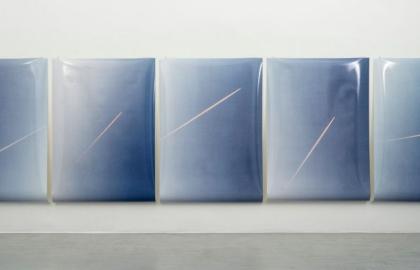
Ann Veronica: Much of my work has to do with perception, with change caused by apparently very simple gestures. One thing I want to do, for example, is to make an experience of duration tangible.
Feldman is one of the great composers of time and sound colour. He creates tiny nuances and sometimes enormous contrasts. Do you sense a connection here?
Ann Veronica: In my installations, movement, volume, transparency, materiality and air quality are part of the composition. When I am preparing for an exhibition, these little silences, sounds and spaces are present in the shapable space. Colours and materials act as counterpoints. I recently started bringing various earlier projects into dialogue with each other. In Milan, for instance, I got works made 40 years ago to resonate with more recent pieces by setting them in motion, making music as it were.

Will your installation in the concert hall also consist of several parts?
Ann Veronica: No, it will be one long movement that lasts for the entire concert. Nothing will be fixed; nothing will be material.
That sounds like the opposite of a classical concert that plays out over a defined duration. Your work isn’t fixed, but it is designed for a specific place and time, if I understand rightly?
Ann Veronica: It has been conceived for Henry Le Boeuf Hall and for the audience. I want to draw the audience into this movement, into dialogue with the music and its meditative character. I want to add image, taste and touch to the music, opening the experience up to other senses.
What existing elements are you going to use?
Ann Veronica: There are still two possibilities at present. Both are intended to evoke the experience of duration in real time, giving the feeling that time is slowing down and yet bearing witness to its passage.
The performance will be held on 19 June, almost at the summer solstice. So it will be a long evening, with sunset at 21:59 p.m., a waxing crescent moon (birdsong is influenced by the phases of the moon), and the Parc Royal nearby... It feels important to me to take these parameters into account.
Serendipity – the coincidental creation of marvellous things – plays an important role in your work and also seems to be part of this idea. Are there other moments when fortunate coincidences can occur?
Ann Veronica: The invitation from Bozar was a fortunate coincidence in itself (she laughs). I mean it. I’d never have thought I’d contribute to a concert. It’s a fantastic opportunity to develop a project in dialogue with a piece of music, with the musicians of HERMESensemble and the Bozar team.

The minimalists and avant-garde composers in New York in the 1970s and 80s – Glass, Reich, Feldman – preferred art galleries to traditional concert halls. Are you trying to reconcile these two types of venue at Henry Le Boeuf Hall?
Ann Veronica: The hall is gorgeous. I will ask to have all the added elements removed – the lighting and sound amplification – to return the hall to the beauty and simplicity of its original design.
It’s true that there is a lot of transversality today. Minimalists work in different spaces, because all spaces are interesting and give rise to new ideas. In my practice, the architecture of the place and the context are very important when starting a project. For Philip Guston is a new adventure.
Another interesting thing is that this work is rarely performed. And when it is performed from beginning to end, it often happens in museums where people are passing by. Now we’re asking people to listen for four and half hours, to nestle themselves inside that duration. How are you approaching the challenge with regard to the audience?
Ann Veronica: It will be a very free evening, because the audience can leave and return whenever they want. Maybe when people leave the hall, they can go for a cup of mint tea or a cookie and then come back. I’d like that.