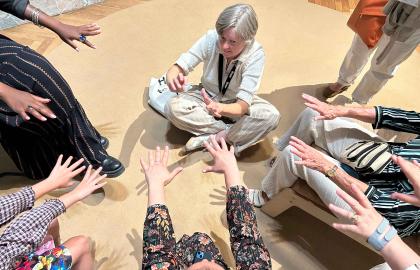
Instead of trying to see as many artworks as possible, we slow down. Four or five works are enough. We fill the time this creates with observation, conversation and silence. What stands out? What moves you? What memory or thought does a work evoke? There are no wrong answers. It’s not about art knowledge, but about engaging with the works and with one another.
Developed as part of the European CARE project, the Relaxed Visits reflect a growing awareness of the role that art can play in supporting mental wellbeing. They are not, however, presented as therapy. First and foremost, they are visits to an exhibition. It is simply that the participants can experience the exhibition at their own pace. It makes a difference, says psychologist and art therapist Jessica Manasievski. She regularly leads groups from Brussels mental health services. What strikes her time and again is how special it is to meet people outside the familiar context of care: not in a consultation room, but among paintings, sculptures and installations.
The process often begins before the visit itself. Participants set aside time, plan their journey and arrange to meet at Bozar. That might seem straightforward, but for people living with anxiety, depression or trauma, it can be a significant step. ‘We see people truly getting into the swing of things,’ says Jessica. Not only literally, but also mentally. The guide’s role is pivotal. They lead the group through the exhibition while creating a safe space in which everyone is free to look, listen or respond in their own way. A conversation might unfold around a single artwork, and the group spends more time with it than planned. Sometimes the silence itself acquires meaning.
“You step out of the healthcare context for a moment, encounter art, and then take something from that experience back with you.”

The story does not always end at Bozar’s exit. In the days and weeks that follow, the experience often continues in creative workshops organised by Jessica and her colleague, Nora Naboulsi, within the mental healthcare sector. Here, they continue the conversations about what the participants saw, felt or thought during the exhibition visit. They provide a space for people to be creative, make things and reconnect with their imagination. Like the Relaxed Visits, the workshops also encourage movement and strengthen connections with others.
The visits and workshops, and what happens within them, often leaves a lasting impression. Participants say that images from an exhibition continue to linger in their minds for days afterwards. Some experience a new-found curiosity about art. Others return to an exhibition on their own. For Jessica, these are valuable signs – not because art solves problems, but because it can open something up: a thought, a conversation, a desire or a new perspective on yourself. This, perhaps, is the very essence of the Relaxed Visits. For an hour and a half, amid all the hustle and bustle, expectations and worries of everyday life, a space opens up where nothing is expected of you. A place where art, if only for a moment, becomes part of the lives of those who stand before the artwork, rather than remaining something remote hanging on the wall.
Funded by the European Union. Views and opinions expressed are however those of the author(s) only and do not necessarily reflect those of the European Union. Neither the European Union nor the granting authority can be held responsible for them.