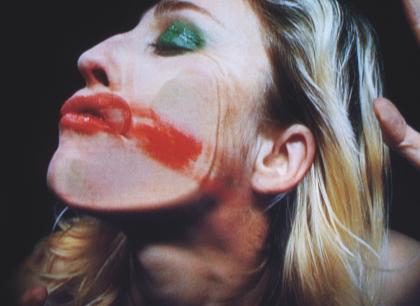
1. Pipilotti Rist
Be Nice To Me, 2000
Let’s start with an image you may have seen dotted around the city – or rather, the image that has found you. We’re talking about a still from Be Nice To Me by Swiss artist Pipilotti Rist. She borrowed her name from Pippi Longstocking, a girl who explores the world in a playful way. The artist follows suit in this video work.
Rist presses her face against the screen in a seemingly childlike gesture that becomes an act of resistance. By smearing her lipstick, she subverts beauty standards and reveals the symbolic violence behind the idealized images that are ubiquitous in public spaces. With this silent scream, she confronts the advertisements and fashion photographs that glorify perfection and desire. Blending humour with discomfort, Rist critiques how the female body is constrained by the media and patriarchal norms – a poetic act of resistance.

2. Okhai Ojeikere
From the series Hairstyles, 1969-1977
J.D. ’Okhai Ojeikere spent three decades travelling across Nigeria, documenting its rich hairstyling traditions. He produced nearly 20,000 negatives and around 1,000 prints, always working closely with the women he portrayed. His images offer a unique insight into Nigerian culture while also broadening our understanding of what art can be. The hairstyles, which range from everyday looks to elaborate creations for weddings and celebrations, are true sculptures: a convergence of taste, social structures, and impressive craftsmanship.
As Ojeikere continued to take photographs, he realized that this tradition was not vanishing but constantly evolving. His work shows how local hairstyles adapt to Western pop culture influences, other African communities, and new tools such as clippers and scissors. The images are not only aesthetically powerful but also serve as important testimonies to a living, evolving culture.

3. Rineke Dijkstra
Kolobrzeg, Poland, July 26 1992, 1992
Dutch artist Rineke Dijkstra ranks among the world’s most renowned photographers. Her series of beach portraits, in particular, is an integral part of the photographic portrait canon. Dijkstra produced this series between 1992 and 1996, capturing teenagers on beaches across Northern and Eastern Europe, including the Netherlands and Belgium.
In this full-length, frontal portrait, your gaze is immediately drawn to the subject. Dijkstra took the photograph using artificial light, a tripod-mounted camera, a long exposure, and a powerful flash. The young subject looks somewhat bewildered by the lens, yet her relaxed, natural posture is more eloquent than words. It is precisely because she is so unguarded that her emotions appear so immediate – perhaps conveyed more honestly than those of an adult. In her gaze and body language, you can occasionally glimpse something of her social background, yet they simultaneously transcend that context. What remains is an almost universal sense of vulnerability and relatability.

4. François Bellabas
Protomaton, 2024
Picture Perfect focuses not only on others, but inevitably on you too – and nowhere is this more explicit than in this particular artwork. The interactive Protomaton uses AI to re-examine the history of automatic portraiture. You encounter the workings of a wall-mounted computer, a camera that takes photos on request, and a series of buttons, each linked to a specific command.
Depending on which button you press, the installation generates different images of the person interacting with the work. Based on your movements, these images are constantly reinterpreted. The idea behind Protomaton – which is as playful as it is perplexing – is that we are continually reinventing our own image and, ultimately, ourselves.

5. Juno Calypso
Slendertone I (The Honeymoon), 2015
British photographer Juno Calypso’s image belongs to a series entitled The Honeymoon. We come face to face with a solitary figure in a retro ‘love hotel’ for newlyweds in Pennsylvania. Joyce poses in the bathroom, as if we have caught her off guard during an intimate moment of her evening routine.
She is wearing shapewear and using the latest beauty gadgets, such as an LED mask and an ultrasonic muscle-toning device. Joyce appears to have been surprised during a transitional moment of isolation and melancholy, yet also seems content in her pursuit of aesthetic perfection. Her face is often veiled or concealed, and it is through this impersonality that Calypso reinforces the idea that Joyce could be any woman.

6. Hank Willis Thomas
From the series Unbranded: A Century of White Women 1915-2015, 2015
What is an advertisement without its slogans? Hank Willis Thomas takes you on a journey through a century of adverts (1915-present) aimed at white women. The series consists of one hundred images, one for each year, seven of which are featured in Picture Perfect. Only the titles allude to the original text that accompanied each image.
Without words, you see things differently – more sharply, more critically. Suddenly, patterns become apparent: who is being shown, how, and why. In this way, Thomas exposes the ideas about beauty, virtue, power, and desire that have been passed down over time – ideas that often prove surprisingly persistent, and sometimes downright problematic.