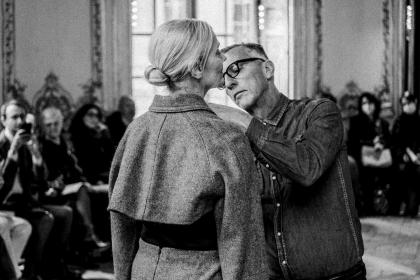
Your Moda povera cycle is not unlike a number of movements in theatre, art and film. One example is the Dogma 95 manifesto, of which Lars von Trier was a key figurehead. As Bozar highlighted at the outset of the season, Dogma 95 rebelled against the film industry. In a similar way, your Moda povera cycle challenges the overuse of special effects that lead to uniform, impersonal products. Your performances run counter to fashion and the fashion industry, and aim for a formal austerity that is both more expressive and more original.
Olivier Saillard: “My work harks back to Arte Povera, in the sense that it seeks to dismantle the foundations of a system, or to break free from it. Above all, it is a refusal to allow fashion to be dictated by what is most elitist, luxurious and marketable. My first performances date back twenty years. Even then, I wanted to prove – and, of course, I was not the first to do so – that you don’t necessarily have to take marketability into account in order to create fashion. You can work in a different way, without distancing yourself from the creation of clothes and their sale in boutiques. I wanted to prove to myself that a much more modest format also exists, one that tends towards a poetry of fashion. In that sense, Moda povera is a means of articulating that making and skill are more important than the ability to sell.
I champion the idea that you can create something without being guided by commercial dynamics. I wanted to reinforce that idea through performance. I refused to let myself be swallowed up by the commercial system of fashion, and rebelled against an exorbitant world that damages our relationship with clothing. Catwalk shows have become a spectacle built on thin ideas. The influence of social media has turned them into something resembling performative events.
I also see a link between a museum function (editor’s note: Olivier Saillard was director of the Palais Galliera, the fashion museum in Paris, from 2010 to 2018) and fashion – or the temperament of fashion – in the hollowing out of the garment. Little attention is paid to who is actually inside that piece. I seek to reclaim that aspect through performance. This becomes even more visible in Les vêtements de Renée, my mother’s clothes. The performance is a way of showing that the person wearing the garment is part of the poetry of fashion. An intimate relationship develops between the designer and wearer, yet so little attention is paid to the latter. A number of major fashion designers, such as Martin Margiela, have highlighted the bodies that wear their creations, but those couturiers can be counted on the fingers of one hand. With Moda povera, I focus on what the clothes, which are not for sale, are capable of expressing. Until now, my performances could be interpreted as a kind of fashion show. But Les vêtements de Renée has made audiences realize that it is about something else.”
The clothes, the posture, the body, the care, the words and poetry are almost systematic components of your performances – as are slowness, repetition and ritual. Do you think of these as a quest for the aesthetics of movement, or are they more like choreographed scores?
Saillard: “I wanted to treat the model’s movements as the physical manifestation of a fashion creation. That fascinated me, because models embody half of fashion and clothing, yet they rarely receive recognition. There is an abstract quality to a model’s posture: a rigid body, a fixed gaze, a body that is either too present or too absent … and yet there are a thousand ways to walk and a thousand ways to move. Sometimes these movements are the translation of a relationship that has developed over time between model and couturier. The body’s expressiveness is already a powerful interpretation of the fashion designer, to which the model gives form. For Les vêtements de Renée, the movements developed gradually. Take the hairbrush, for example. It initially had a practical function: I used it to tidy Axelle Doué’s hair after she had donned a garment, so that she would not look ridiculous. That seemingly silly action has evolved into a gesture that expresses poetic attention. I like the fact that we do not have everything under control. Fashion is an industry that does not like uncertainty, that writes its own scripts. It has lost its penchant for the unexpected.
We utilized the way in which Axelle removes a garment without it resembling a striptease. We explored how to present a ‘fashion show’ without resorting to theatricality or caricature. Our movements serve the garment and the intimate, without further embellishment.”
For your performances, you collaborate not only with Axelle Doué, as here in Les vêtements de Renée, but also with the model Kristina De Coninck and the actress Tilda Swinton – and occasionally with other fashion designers.
Saillard: “It is probably somewhat impolite to talk about age. The models, or Tilda, or the couturières fascinate me because of their knowledge of heritage, the place they occupy in fashion history, and the territory to which they lay claim. To me, they have the status of muses or models, but what fascinates me most is the living heritage they embody – the heritage value of their experience, skill and stories. As a fashion historian, I am deeply attached to the concept of living archives, and my performance partners enjoy working around that aspect. They were extremely touched when I first approached them. A model’s career is short. Models used to spend much more time with designers than they do today; they were part of the studio ecosystem. During my conversations with them, I noticed that they looked back on that past with pleasure – to a time when the fashion industry was no longer willing to discuss the past or age, and was resolutely focused on the future.”
With your relationship to fashion, you break away from the commercial system and, in a sense, champion the subjectivity of fashion, which likes to create strict definitions of beauty. You create a space in which beauty can be expressed through the poetry of time, words and history.
Saillard: “Gracefulness. Gracefulness rather than beauty. For me, beauty is linked to a body or a garment’s ability to tell a story and evoke feelings, particularly through subtle details. Beauty is subjective, and the fashion industry can render us unable to appreciate it. During my performances, the audience is not always convinced that my partners are, or were, models. They see a careworn face or a slightly plumper body, rather than a face or body that tells a story or reflects an experience. You cannot halt the ravages of time, of course, but that is not the point. Beauty is expressed in experience and skill. It is about the heritage of living archives that they embody. And that is what I want to illuminate in my performances.”
The archive and poetry …
Saillard: “You sometimes hear that poetry doesn’t pay. I think this is the vulnerability that I’m chasing as I invent my own fashion territory.”
3 + 4 Apr.’26 - Olivier Saillard. Moda povera V: Les vêtements de Renée