Could you tell us a little more about the theme?
Ramzi Aburedwan: ‘For Palestinians, land is more than just a geographical space; it embodies memories, history and identity. Our connection to this land is intimately tied to our ancestors, the changing seasons and landscapes dotted with olive trees. Now that this connection is under threat, we seek to affirm our dignity and our very existence through song.’
Could you quote a piece of poetry that illustrates this ?
Aburedwan: ‘One of the project’s key texts is by Mahmoud Darwish: "We have on this land, that which makes life worth living." This sentence reminds us that our country is, above all, a place of creation, love and hope.
Hussein Barghouti’s ideas also inspire the project, in particular by these powerful statements: "And if the olives live on in their oil, then the mountain lives on in its olives." Or "Whenever I see an almond tree, I feel as though I am seeing a naked woman performing some kind of pagan ritual."
Finally, there is this beautiful passage in which the land becomes the keeper of memories and secrets: "If you can’t keep a secret, dig a hole in the ground and tell it the secret, then pile dirt on it and bury it in that hole. It will come back to you when spring comes: each blade of grass or a narcissus that comes up will bring the secret back to the surface. No one will be able to hear that secret except you."'
In your opinion, what is the role of music in times of war and division?
Aburedwan: ‘Although music cannot stop wars, it preserves our humanity amidst the violence. It creates space for empathy and reminds us of what we share across borders. Where words sow division, music fosters a sensitive dialogue.’
This is an ambitious, multidisciplinary project. What can audiences expect?
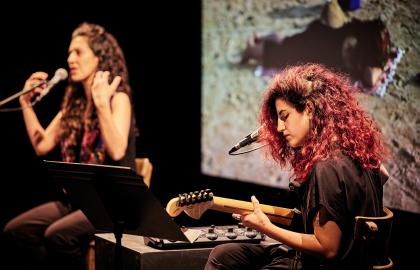
Aburedwan: ‘First and foremost, a large ensemble of eighteen performers. The compositions interweave with visual creations inspired by landscapes, everyday life, collective memory and optimism about the future. The aim is to create a space where the various forms of expression resonate with the audience’s emotions.’
You grew up in a Palestinian refugee camp. Could you ever have imagined, back then, that your projects would be showcased throughout Europe?
Aburedwan: ‘No, in the Al-Amari camp, the horizons seemed limited. Music has opened unexpected doors for me, enabling me to share the stories of my people across the globe. The fact that this project has reached so far today is down to art’s ability to transcend boundaries and build bridges between people.’