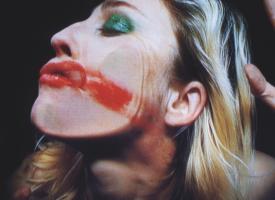
Beauty through the lens
Whether we acknowledge it or not, the pursuit of beauty permeates everyday life. From the bathroom mirror to social media feeds, from magazine covers to cosmetic surgery clinics, the pressure to appear “picture-perfect” has become an omnipresent reality. Youthful skin without blemish, sculpted bodies and flawless smiles are daily
benchmarks against which self-worth is measured. “The choice of lens-based media artworks in the exhibition emphasizes the strong link between beauty and photography” explains Christel Tsilibaris, curator of the exhibition. “It highlights how crucial it has been as a tool for promoting aesthetic trends and beauty products. Now central to our daily existence and always close at hand in our smartphones, the camera has led the way in enhancing appearances and creating unachievable goals.”
Deconstruction
“The time has come to broaden and redefine the concept of beauty” points out Christel Tsilibaris. “The artists in Picture Perfect critically address Western beauty standards but, more importantly, they reject judgement, by proposing beauty as a space of freedom and humanity.”
Conceived as a critical declaration, the exhibition unfolds through intertwined movements of deconstruction and recuperation. It traces the historical foundations of Western beauty standards, perpetuated through centuries of art history and reinforced by mass media and digital algorithms. From the 1970s onward, artists began to confront and dismantle these inherited canons through self-portraiture, performance, appropriation and documentary strategies. At the same time, many artists reclaim beauty as a relational force and a vehicle for emancipation, proposing new visual languages that embrace vulnerability, diversity, aging, queerness and hybridity.
Reclaiming the gaze
Photography occupies a central place in the exhibition. Historically instrumental in shaping beauty norms, it has promoted aesthetic trends and products worldwide. Yet it also contains the seeds of critique. Rather than opposing aestheticization outright, Picture Perfect embraces the ambiguity of the lens, foregrounding dialogue between artwork, artist and audience. The exhibition decentralizes the gaze, expanding representation and questioning who has the power to define desirability.
While addressing the oppressive dimensions of beauty, the exhibition resists moralizing. Instead, it creates space for reflection and encourages visitors to question how they see. “Picture Perfect encourages us to open our eyes and look afresh at the standards of physical beauty that society attempts to impose upon us” says Zoë Gray, Director of Exhibitions at Bozar. “However, in a world that is quick to pass judgement, this exhibition is the opposite of judgemental. Instead it is open, generous, playful and inspiring. It boosts self-esteem while sharing the work of a wide range of artists, from the established to the emerging.”
Beauty is approached as a force that can both constrain and empower. In a time when aesthetic procedures and digital filters intensify scrutiny of appearances, Picture Perfect responds with urgency, asserting that beauty is not a static object but a dynamic terrain of struggle and possibility.
Echoes
After exploring love in 2024 – with the exhibition Love is Louder -, physical beauty is the second thematic exhibition at Bozar focusing on what motivates us as humans. It also echoes with the exhibition Bellezza e Bruttezza (20 Feb. → 14 June'26) that explores beauty and ugliness in the Renaissance.
Zoë Gray sums up: “Picture Perfect examines the role of the camera in the creation, perpetuation and deconstruction of established ideas about physical beauty. Focusing on lens-based media from the 1970s to today, it is the perfect complement to the parallel exhibition Bellezza e Bruttezza, revealing the continuity of Western beauty standards throughout the ages, but also revealing how contemporary artists challenge those traditions and archetypes.”

Bozar Arcade
Bozar Arcade, the space dedicated to interactive digital artworks and video games in Bozar, is included into the exhibition Picture Perfect, in the last room. Over the past couple of years, video game and digital culture have acquired a strong foothold at Bozar.
The bi-annual Bozar Arcade approaches societal topics through the vision of artists and independent game-makers. For this edition, Bozar Arcade is the closing chapter of the Picture Perfect exhibition. Aiming to engage with the theme of beauty, it showcases a selection of playful existing works and a new creation that the
audience can interact with directly.
Curation Bozar Arcade:
Emma Dumartheray, Exhibitions & Bozar Digital Coordinator
Jafar Hejazi, Digital Dramaturge, Bozar
Picture Perfect shows works by:
Ibrahim Ahmed, Yumna Al-Arashi, Francesca Allen, Sarah Amrani, Susan Anderson, Eleanor Antin, Alexandra Barancovà & Jae Perris, Baloji, Valérie Belin, François Bellabas, Kwame Brathwaite, Nakeya Brown, Juno Calypso, William Cobbing, John Coplans, Eli Cortiñas, Nicola Costantino, Laure Cottin Stefanelli, Mélanie Courtinat, Sara Cwynar, Rineke Dijkstra, Philippe Durand, Sylvie Fleury, Bryce Galloway, Moshtari Hilal, Anne Horel, Sanja Iveković, Yuki Kihara, Sandra Lazzarini, Ethel Lilienfeld, Linder, Lucy&Bart, Luna Maurer, James McColl, Ana Mendieta, Haley Morris-Cafiero, Zanele Muholi, Zed Nelson, J.D. ‘Okhai Oijekere, ORLAN, Frida Orupabo, Guillaume Pauli, Andrés Pérez, Cara Phillips, Momo Pixel, Angelo Plessas, Marilou Poncin, Chantal Regnault, Pipilotti Rist, Martha Rosler, Errol Stanley Sawyer, Cindy Sherman, Marianna Simnett, Sin Wai Kin, Ruofu Sun & Alice Yu, Ryudai Takano, Amélie Testenoire – Lafayette, Maria Tsagkari, Kristina Varaksina, Hiroshi Watanabe, Hannah Wilke, Hank Willis Thomas, Roel Wouters, Garry Winogrand, Aviya Wyse. Soutien: NextGenerationEU, Pro Helvetia, The Swiss Arts Council, Creative Europe, Programme of the European Union, Goethe-Institut, Halaqat
Support: NextGenerationEU, Pro Helvetia, The Swiss Arts Council, Creative Europe, Programme of the European Union, Goethe-Institut, Halaqat