I’d like to start by thinking about your work as a whole and to reflect about how your films move between what you live, know, discover and your imagination. It’s tempting to look at many works of yours, É Noite na América [It is Night in America] (2022), for instance, as documentaries when they are much more than that…
Ana Vaz: "I struggle with the idea of the “whole.” Inside “whole” there is a “hole”: a rupture, an interval, a fragment that is latent, also something underground, that we struggle to access. I like to consider the whole as hole: an excavation, a delving into, an unknown path, which is akin to how I think of cinema. Perhaps not coincidently editing rooms are often underground spaces. When entering the editing room, it takes me a long time to find out what the images and sounds are asking for, and editing is all about listening to matter and finding ways that allow it to resonate, to exist, to emerge. The other day, a friend aptly described my “going under” the editing suite as a movement akin to a whale’s dive. You take a deep breath and go under for as long as you can, then re-emerge. At the moment, I’m going through one of these whale-like moments of deep duration with material I’ve been gathering for many years, as if I was diving into the space of dreaming, a kind of consciousness that escapes the single way of perceiving time and space as organised by the spectrum of settler time.
I grew up in a place particularly haunted by the consequences of settler time, a region haunted by many presences and forms of life - spectral, vegetal, animal, human - rendered invisible through the imposition of the forward moving arrow of modernity. Brasília, Brazil’s modernist capital reenacts the country’s colonial history, this time rendered docile through the veneer of modernism. Built in three years under the auspices of a terra nullius, it is shaped by the usual arrogance of modernity, which denies the existence of anything prior to its own existence. Being born in a place so focused on cutting relationships with the past, my endeavor was to connect with what had been buried. This underground dreaming or consciousness that insists on emerging is connected to how I practice cinema. Cinema for me is a practice, my martial art to fight against processes of imposed effacement.
We could then conceive of the document or the “documentary” as the privileged mode of rendering visible, of creating new regimes of truth, of classifying and often enclosing the instability innate to the living - modernity’s ceaseless quest. This is why despite my firm engament to work against effacement, I refuse to prolong modernity’s truth making prophecies by proving documents, by being documentarian. Documents are the work of bureaucrats, cinema is all about the abyssal, a concept dear to my father, Guilherme Vaz, whose music is often the narrative soul of my films. Cinema is for me a practice of tuning into manifestations of both the living and the dead, not representations of them, but manifestations, which is an entirely different way of thinking. I try to move away from the pathos of the “metaphor”, from the idea of “this is like…” I’m interested in forces that transgress our understanding, that resist representation, enclosure, capturing. Forces that connect us to the enigma, a dimension of life that has been purged and chased from our existences in a witch-hunt that lasts over five centuries now. Our histories have been written over graves and extinctions of many histories so that a single monumental history recovers all the rest, this is modernity. In a way, I think my practice stands at the opposite spectrum of documentary. I don’t think in any of my films I am documenting but perhaps facing manifestations of astonishment."
Is this practice of astonishment something that triggers the beginning of a film? What are the instances that initiate a project?
Vaz: "If we consider that astonishment places us in front of something hard to address, to grasp, to enclose, then yes. They often rise from a sense of astonishment, perplexity or revolt. Also, I feel that often my films are made with a sense of urgency. Hence, they are imperfect, unstable, and open ended as they each continue something from the previous work. I guess I try to release cinema from its complicity with settler values around the heroic, herculean, masterful work. Away from the pathos of the masterpiece and the master. I am interested in the collaborations and confabulations that emerge in filmmaking. I trust the movements, encounters and alliances that it generates as a practice, rather than a means to an end. Hence, I am unconsciously often sabotaging its codes.
If we honor astonishment, we honor vulnerability, fragility, imperfection, and instability. Take É Noite na América: there is no way I could write that film. It is an imagined, intuitive score that emerged from lived experience. As I begin finding bodies of animals suffering from habitat destruction caused by monoculture in a political context marked by ecocide and fascism, I read these encounters as a calling. That’s when you connect to a kind of subterranean dreaming, to another temporality that refutes to be silenced and buried, that asks you to honor its existence. I started filming within a week, using expired stock: why would I work with new stock when dealing with extinction when image-making is so closely aligned with processes of extinguishment?"
You situate yourself within this complex inheritance of Enlightenment, which shaped who we are, what we desire, how we think and gave us the illusion that we are entitled to see everything. The camera reinforces such entitlement so you must decide what to show and not, histories to tell and not. Bringing images that reveal decimation, pain and epigenetic trauma, without reverberating violence is so hard. How do you decide what troubles and wounds to show and not to show?
Vaz: "A camera is a prosthetic apparatus. There is a relationship often denied in the history of moving images between the body that feels, films, listens, witnesses, and what, who and how we see. Western universalism is based on a pact of non-reciprocity: I see you, but you cannot see me. There is no greater violence. No one sees alone. Historically, the observer in the West is rendered omnipotent, this is where the violence reverberates. They believe they can see but cannot be seen. There is rarely an ethnography of Europeans, while Europeans have made countless ethnographies of others—never understanding they are always representing themselves more than those they claim to depict.But what happens when seeing is acknowledged as a pact, as a reciprocal act? When the observer is no longer omnipotent, but rendered part of a pact hence vulnerable, unstable, uttering, breathing, thinking as they see?
I began working with the camera not to see but to be present—with, alongside. In É Noite na América, there are moments of body-to-body, lens-to-reality intimacy that prevent distance, clarity, capture. Something always escapes as representation but emerges as a manifestation."
It would be easy to associate the explosion of these caterpillars with ecological imbalance, and yet you allow them to be more than a metaphor. By being curious about them, you understand they are important ecological agents. This brings me to the encounters you have with land, geologies and animals that appear in your work. How do you allow them to lead the way, to choose how they appear in your work?
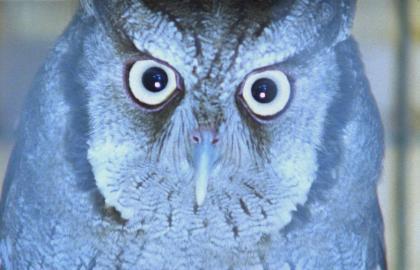
Vaz: "The living is made of many pacts - some we understand, some we don’t, because we are not at the center of them. These pacts precede us and will continue after us. Each film is part of a pact. What you see are not mere representations; none of these beings are enclosed in these narratives. They are not explained nor frozen. They pass. Sometimes it feels as if they lend us their ghostly double and leave. For instance, in É Noite na América, the owl that looks at us so deeply is an owl but is also something else that we can’t name but recognize. It’s a scream, the return of the gaze, a reminder that you never look alone. That was my feeling in front of that owl-what it was asking not only of me, but of us. The same with Macau, the giant otter who refuses to be anchored or framed. He constantly escapes the frame. Cinema is minor in the face of life. The arrogance of the medium is to think it can be at the center of the pact. If you’re not at the center, your experience is different. What matters is not the image I’m making but something else, the expression of a force, a latitude, a manifestation. Every decision is made from within a pact with another being who places you in a liminal position, one in which you are never the master. "
Animals cross the frame. Voices come from people we don’t see. While panning, the camera shows us the impossibility of seeing everything and how cinema constructs and how life extrapolates beyond it. Indeed, so much in your films happens off-screen. And then there is your work with sound and music. Sound can be so manipulative in cinema. It can create expectations, tension, and empathy. In your work, sound is almost like another creature. Given the legacy of your father, Guilherme Vaz, and thinking of sound as preservation and transmission, I wanted to ask about the sonic dimension in your work, both musical and non-human.
Vaz: "They are deeply connected. At first, I wasn’t aware, but later, through listening and making these films, I understood that my father’s interest in composition was always the world and the living-music before music. Storms, winds, rivers, cries, animal sounds are innate to his compositions. Cage speaks of silence making space for the world to speak, but in Cage silence is formal, aesthetic, controlled. My father’s interest was the opposite: the work is never about the artist but freed from them.
The sonic is feral. It cannot be controlled. Modernity’s secular flattening privileging the rational and quieted everything and everyone else. Modernity is a fight against the spectral. Guilherme’s works and mine are a pact with their presence. To break with modernity would not imply a simple breaking away from it and a return to the past, but rather a confrontation with the spectral. The being you named - a creature of sorts- inhabits the works. It has agency because it was always already there. In my father’s compositions or in my films, there are spaces for eruptions, for what was always present to emerge. We aren’t inventing anything.
There’s a tension between the musical and the elemental. Through a transgenerational incantation, the works continue to speak - to each other and to us. I often take compositions my father made in one context into another. Hearing Panthera onça, an orchestral composition he made for another film by Sérgio Bernardes, over the crepuscular images of Brasília during the imminence of a coup in 2021—astonished me. It felt written for that moment. There is a form of epigenetic conversation that traverses us, not only us in a patrilineal sense but also our known and unknown ancestors."
Ana Vaz was born in 1986 in Brasília, her work is rooted in a territory haunted by the buried ghosts of this utopian city, at once a symbol of promise and of fracture. Filipa Ramos, PhD, writer and curator, bases her research on the ways contemporary art engages with nature and ecology.
Filipa Ramos, PhD, is a writer and curator. Her practice-led research focuses on how contemporary art engages with nature and ecology. She is the artistic Director of Loop Barcelona.


*Funded by the European Union. Views and opinions expressed are however those of the author(s) only and do not necessarily reflect those of the European Union or the European Education and Culture Executive Agency (EACEA). Neither the European Union nor EACEA can be held responsible for them.