Light for all things
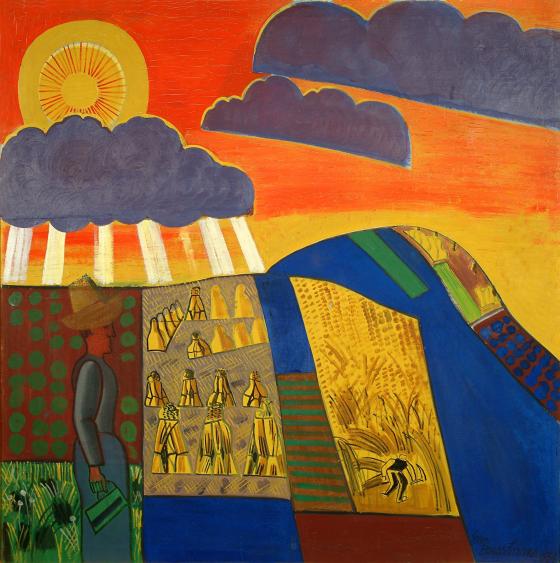
Brusselmans’s view of the world was as modest as it was profound. He painted simple elements from his immediate surroundings and imbued them with a monumental presence. “Art lies in casting light on all things, even the most thankless and the poorest.” he said. For him, there was no hierarchy amongst subjects. This conviction went hand in hand with a social awareness: “I had long realised that there was a need for strong and popular art.”
A journey in twelve chapters
The exhibition takes 1914 as its starting point, the year in which the artist settled in Auderghem and turned his back once and for all on academicism and realism.
Through a thematic and chronological approach, divided into twelve chapters, Painter by Nature traces his evolution up to the early 1950s: the journey of an artist who relentlessly sought the essence of things and strove to organise chaotic reality into clear and reasoned compositions.
This is how Brusselmans’s unique pictorial language developed, taking on its characteristic form from the 1930s onwards, oscillating between figuration and abstraction, tradition and modernity, reality and imagination, serenity and dramatic intensity.
Dialogues with his contemporaries
Additionally, some striking dialogues with (inter)national contemporaries – such as Fernand Léger, Piet Mondriaan, Giorgio Morandi, Rik Wouters, Victor Servranckx or Constant Permeke – shed light on Brusselmans within the context of his era.
These dialogues reveal sources of inspiration and artistic affinities while, above all, highlighting his distinctive position: one that can only be described as radically autonomous.
Kristof Santy: a contemporary view
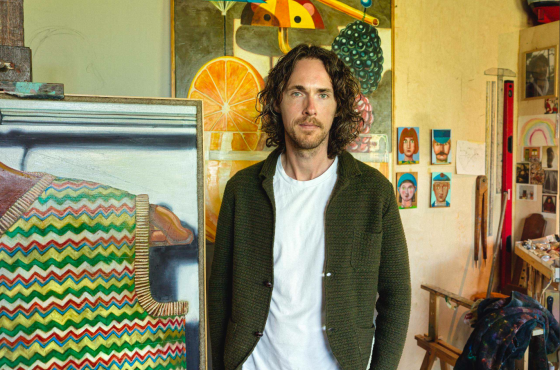
Jean Brusselmans’ work continues to inspire younger generations of painters today. Kristof Santy (born in Roeselare, 1987) is one of them. For this exhibition, Bozar invited Santy to undertake a special commission that brings him into direct dialogue with the master’s lost works: the four monumental sets that Brusselmans painted in 1936 for the performance of Schönberg’s opera Erwartung at the Centre for Fine Arts of Brussels. These seven-metre-long panels have not survived. Drawing on the few available archival documents, Santy has recreated the sets for the first and final acts, using a technique new to him: pastel on unprepared linen canvas. The result is entirely personal, whilst remaining faithful to the master’s pictorial language. “I made it with my own hands, but the thinking behind it is shared with Jean Brusselmans”, explains Santy.
A singular approach
Brusselmans’ work spans almost the entire first half of the 20th century, a period during which European art shifted from the realism and academicism of the 19th century to a host of new movements, ranging from Luminism and Brabant Fauvism to Flemish Expressionism, Surrealism and Constructivism.
Brusselmans was generally described as a Flemish expressionist, a label with which he himself strongly disagreed. Despite belonging to various artistic circles, such as L’Effort, the Brabant Fauvists, La Libre Esthétique, L’Art vivant, Les Compagnons de l’Art and Kunst van Heden, he remained an individualist.
He translated his personal world and his very way of being into an authentic pictorial universe, where, in his own words, “not a single brushstroke is too many or too few.” Brusselmans sought to paint “naively, purely and powerfully, to be natural.”
Back at Bozar
With this exhibition, Brusselmans returns to the Centre for Fine Arts Brussels, where he had held his first major solo exhibition in 1931. His connection with the institution was close and multifaceted: he was a founding member of the artists’ group L’Art vivant, which had its premises there, and created monumental theatre sets for the operas staged there, such as Schönberg’s Erwartung (1936) and Vondel’s Lucifer (1937). During his lifetime, the Centre for Fine Arts was a major promoter of his work, hosting three major exhibitions in the 1930s and a fourth in 1952. Posthumously, the Centre for Fine Arts dedicated a further exhibition to him in 1979.

“I had long realised that there was a need for a strong and popular art.”
“Art lies in casting light on all things, even the most thankless and the poorest.”
“My painting is neither mystical nor Christian. It is a hymn to nature — a pagan nature, loved for its beauty alone.”
“In art, every genre is difficult. Painting an oil lamp requires just as much talent as painting the portrait of a marquise.”
“Colour is free. It is not governed by any rules at all. It must be contrived by the artist. It is light and dramatic feeling."
“For this exhibition, we have made every effort to offer a renewed perspective on Jean Brusselmans’ oeuvre. Extensive research enabled us to trace exceptional works from private collections that have not been shown to the public for decades—in some cases, for as long as 45 years.
Several paintings were also specially restored for the exhibition and examined using infrared reflectography or X-radiography, providing new insights into Brusselmans’ artistic process. We are delighted to share these discoveries with the public and to offer a fresh perspective on a unique figure in Belgian modernism.”
"Few Belgian artists are as closely associated with the early years of the Centre for Fine Arts as Jean Brusselmans. In this respect, he belongs alongside James Ensor, Constant Permeke, Paul Delvaux and René Magritte. In a sense, they grew and developed alongside the Centre for Fine Arts. Amid the maelstrom of the various ‘isms’ of the time, they demonstrated what art vivant could mean in painting.
At the opening of his first retrospective in 1931, Brusselmans said: ‘A work of art is a struggle – against everything that offers resistance, against the destruction and death we carry within us. That is why artistic creation can only ever be alive: even as it continually dies in its form, it is immediately reborn in countless guises, with ever-new reasons to claim its place in the world of dreams and splendour.’"
“When Ann Geeraerts proposed this exhibition, I was immediately convinced of its pertinence for audiences in Belgium and for Bozar’s programme. I am so excited to see so many of Brusselmans’ works together in one exhibition, having previously only been able to see small selections of his paintings in various institutional collections. Thanks to our close collaboration with several Belgian museums, Geeraerts brings together here many of these official 'national treasures’ with seldom seen works from private collections. The range of lenders attests to the broad appreciation of his work, which I hope will only grow with this exhibition and its accompanying catalogue.”
“By presenting Brusselmans’ work in dialogue with that of his contemporaries - both national and international - this exhibition shows how this painter by nature was continually striving to develop his own practice and to push the medium of painting itself. I am particularly struck by his treatment of the landscape, which he depicts like a patchwork of abstract forms and tangible brushstrokes, while never abandoning figuration."
Partners: Royal Museums of Fine Arts of Belgium, KBR, MSK Ghent, Musea Brugge, Mu.ZEE, Royal Museum of Fine Arts Antwerp.
Alongside the exhibition, the Royal Museums of Fine Arts of Belgium, as major lender, are presenting some thirty works on paper by Brusselmans in the Spilliaert Room of the Old Masters Museum, just a stone’s throw from Bozar. The exhibition "Jean Brusselmans: The Artist at Work" runs from 18 Nov. to 9 May ‘27.