- A child prodigy with a difficult childhood
Béla Bartók was born in 1881 in a small Hungarian town (today located in Romania), into a family of amateur musicians. His musical talent became apparent at an early age, but his childhood was difficult: until the age of six, he lived isolated from other children due to illness.
- Patriotic pride
Bartók grows up at a time when Hungarian identity is under pressure from the Russian, German and Austrian empires. In the late 19th century, Brahms and Wagner dominate the musical landscape. Bartók begins to ask himself: how can I create a truly Hungarian musical language, separate from that German heritage?

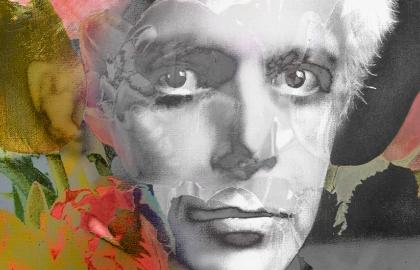
Bartók ca 1918 © Bartók Archives, Budapest

Young Béla Bartók at age 22 Young Béla Bartók at age 22
Bartók ca 1918 © Bartók Archives, Budapest
Young Béla Bartók at age 22 Young Béla Bartók at age 22
- Singing villages
After meeting composer Zoltán Kodály, Bartók immersed himself in folk music. With phonograph in hand, he travels from village to village, recording thousands of folk songs. He later extends his research to neighbouring countries: he collects Slovak and Romanian melodies, and even travels as far as Turkey and Algeria. His work is later seen as pioneering work in ethnomusicology, the study of music as a cultural and social phenomenon.
- His music
Initially influenced by Strauss, Liszt, Brahms and Debussy, Bartók found his own voice thanks to folk music. This blend of traditional melodies and classical formal language lays the foundation of his unique style, which is later enriched by influences from Stravinsky and Schönberg.
- The piano teacher
In 1907, Bartók is appointed to the Royal Academy of Budapest, where he will teach for most of his life. He taught piano, but never composition: technique can be taught, he felt, but creativity is your own.
- The King of Swing
In 1938, Bartók received a remarkable commission from Benny Goodman, the famous jazz clarinetist of Sing, Sing, Sing. The result is Contrasts, a surprising work premiered at Carnegie Hall in New York.
- Fear and resistance
The rise of Nazism in the 1930s caused Bartók deep unease. Disgusted by fascism, he refused to have his music played at Nazi concerts and switched publishers as soon as they identified with the regime. In his will, he stipulates that no street should bear his name as long as a Hitler or Mussolini street still exists.
- Bartók in Brussels
With the rise of fascism, Bartók spends more and more time in Brussels. There he met the Antwerp musicologist Denijs Dille, who would devote much of his life to Bartók's legacy. Thanks to Dille, our Royal Library today has a huge archive on the composer. Brussels is also honouring Bartók with a statue on the Spanjeplein. This work by sculptor Imre Varga was donated by the city of Budapest in 1995 to mark the 50th anniversary of Bartók's death.

Statue of Bartók in Brussels Statue of Bartók in Brussels

Contrasts by Bartók Contrasts by Bartók

Béla Bartók Béla Bartók © Bildarchiv-und-Grafiksammlung
Statue of Bartók in Brussels Statue of Bartók in Brussels
Contrasts by Bartók Contrasts by Bartók
Béla Bartók Béla Bartók © Bildarchiv-und-Grafiksammlung
- In exile
Although strongly attached to his homeland, Bartók left for the United States in 1940 . He dies there in 1945, still bursting with plans and ideas. His last words would have been: ‘Too bad I have to leave while my suitcase is still full.’
- A lasting legacy
Bartók's influence extends far beyond his own compositions. Through his collection and arrangement of folk music, he laid the foundations for modern ethnomusicology. He combined the musical currents of his time into a language that was at once personal and universal, and which still resonates today in the music of many composers.
This article appeared in the magazine of the Belgian National Orchestra. We thank them for its use.