In 1978 – at the age of 26 – he founded the Yellow Magic Orchestra. Five years later he was acting alongside David Bowie on the set of Merry Christmas, Mr. Lawrence, and another four years after that, he won an Oscar and a Grammy for his score to Bernardo Bertolucci’s film The Last Emperor. The whole world listened to his music at the opening ceremony of the summer Olympics in 1992, you could download his ringtones for Nokia in 2006, and he was among the activists protesting against nuclear energy after the Fukushima disaster in 2011. Ryuichi Sakamoto seemed to lead several lives at the same time. And even more remarkably, he was an influential figure in each of those lives.
“All music is very close to me, and I generally don't care about genres. I listen to anything; I create almost any kind of music. I understand that sometimes people might be confused about what I am. That's why I kind of focus on what I'm doing. But then I get bored with what I'm doing ...” - Sakamoto in an interview with Steve McClure in 1996
Yellow Magic and hip hop
Sakamoto’s musical career began traditionally enough. As a child, he learned the Western classics and developed a great love of Debussy’s music. When he turned eighteen, he went to the University of the Arts in Tokyo. Besides studying composition there, he also cultivated an interest in ethnomusicology and electronic music. Even back then, it was clear that his musical horizon was extremely wide. He soon started working as a studio musician and arranger. That brought him into contact with important Japanese singers such as Tomobe, Eiichi Ōtaki and Haruomi Hosono. His own musical language gradually took shape, and the world met the young man from Japan through the successful Yellow Magic Orchestra that he founded.
This band set itself apart from other groups by committing entirely to electronic sounds. Along with synthesizers of all shapes and sizes, they used drum computers and vocoders to create a unique, innovative sound. European groups such as Duran Duran and Depeche Mode would later be influenced by the YMO’s eclecticism. Around the same time, Sakamoto also released a solo album called Thousand Knives of Ryuichi Sakamoto, in which he combined traditional Japanese and Chinese music with electronics.
His second solo album, B-2 Unit was equally innovative, and best known for the track Riot in Lagos. It is generally accepted today that this track laid the foundations for the development of both techno and hip hop. In particular, the specific sound of the beats Sakamoto made would be frequently imitated, by Afrika Bambaataa and Kurtis Mantronik among others.
Silver screen
Although the impact of his solo albums and the YMO’s music is probably Sakamoto’s most important legacy from the perspective of music history, his film music is what earned him worldwide fame and appreciation. In fact, though, he got into it almost by coincidence. The director Nagisa Oshima asked him to act in the film Merry Christmas, Mr. Lawrence. In a fit of self-assurance and ambition, Sakamoto only agreed on the condition that he could write the music for the film as well. The ball started rolling, and he grew into one of the most important Japanese film composers of the 20th century. Likewise, he was initially asked to work on The Last Emperor as an actor, until suddenly a scene needed music with a small orchestra. He ended up writing the full soundtrack, which combined authentic Chinese music with the sound of a (Western) symphonic orchestra. For The Sheltering Sky, with its portrayal of the loneliness of the North African desert, he opted for a large string orchestra and relatively static fields of sound to reflect the film’s desolate atmosphere.
Throughout his career, he continued to alternate film music – a genre he found inspiring but also very stressful – with solo projects and other musical genres. In 2015, he composed a totally different soundtrack for the film The Revenant. Long, sustained notes and ambient sounds contribute to the tense atmosphere and testify to Sakamoto’s lifelong fascination with sound.
Where that fascination was mainly expressed in a search for new (electronic) sounds and beats in the early years, his attention shifted in later years to a more concentrated focus on subtle acoustic phenomena. In Ryuichi Sakamoto: Coda, a documentary from 2017, we see how the composer is mesmerised by the resonance of cymbals and gongs, but equally by the patter of rain on the roof. Standing in the rain with an upturned bucket on his head and making field recordings of sounds in nature is also Sakamoto.

A socially engaged artist
“If I feel strongly about something, I cannot look away”
-- Ryuichi Sakamoto in the documentary OPUS
Aside from his musical career, Ryuichi Sakamoto was profoundly concerned with social and ecological issues. He saw the attack on the World Trade Center on 11 September 2001 with his own eyes and reacted with an opinion piece entitled “To Not Retaliate Would Be True Courage”. After the nuclear disaster in Fukushima, he was among those at the forefront of the biggest popular protest in Japan in more than thirty years. He addressed the crowd of 170,000 protestors on the need to stop using nuclear energy, closing with the iconic words “Keeping silent after Fukushima is barbaric”. Later, he released his own collection of frames for glasses, in support of the organisation moreTrees. In the aforementioned documentary Coda, he explores the sound of a piano that was damaged during the tsunami that caused the Fukushima disaster. In this gripping scene, his social engagement and artistic practice meet. He incorporated the results of his field recordings into his later work, including his last album “async” (2017), where he combined it with new music inspired by Bach. In this way, he brought the sound of vulnerable nature into his sound universe.
1996
In 1996, Sakamoto released a new album called 1996, without electronic sounds this time. There are sixteen tracks on the album from different periods in his career, mostly film music, and all arranged for a piano trio. The composer himself played the piano, with Jacques Morelenbaum on the cello and various violinists. This choice of instrumentation is not that surprising, since Sakamoto had been fascinated with the great classical composers, such as Beethoven and Debussy, since his childhood. In these intimate instrumental versions, the essence of the music emerges in all its purity: melodic inventiveness, atmospheric harmonies and a generally calm cadence.
Also in 1996, Ryuichi Sakamoto took this music on tour. Live performances of his music tend to be rare, unless he was on stage himself. In this sense, it is unusual that the Bang on a Can All Stars have chosen to tackle this repertoire.
Bang on a Can
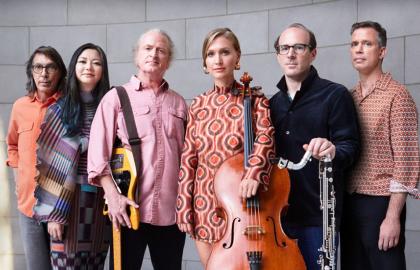
Bang on a Can All-Stars, the ensemble based at Bang on a Can that travels around the world giving concerts, has made new arrangements of the classics on the 1996 album. The clarinettist Ken Thomson extended the ensemble’s musical resources to include extra strings, percussion, the electric guitar and clarinet. For these arrangements, he went beyond the album itself, returning to the original compositions and other arrangements that may have existed. In doing so, he has given Sakamoto’s timeless melodies a new impetus.
Although Ryuichi Sakamoto is not one of the many composers who have worked with Bang on a Can, his music does resonate with the interest in minimal music and sound-focused compositions that characterises the American collective. In particular, the minimalistic and somewhat rawer track 1919, composed especially for the 1996 album, suits Bang on a Can’s aesthetic. The arrangements highlight new aspects of the Japanese composer’s unusually diverse oeuvre.